

Why are you still waiting for a bank assessor to "get around" to your file while your dream property drifts toward a sunset clause? Learning how to speed up mortgage approval isn't about asking nicely; it's about architecting a submission so precise the lender has no choice but to green-light it immediately. You've likely felt the sting of endless back-and-forth and the frustration of conflicting document requirements that seem to shift every time you hit "send." It's a high-stakes game where a slow finance clause can cost you the keys to your home.
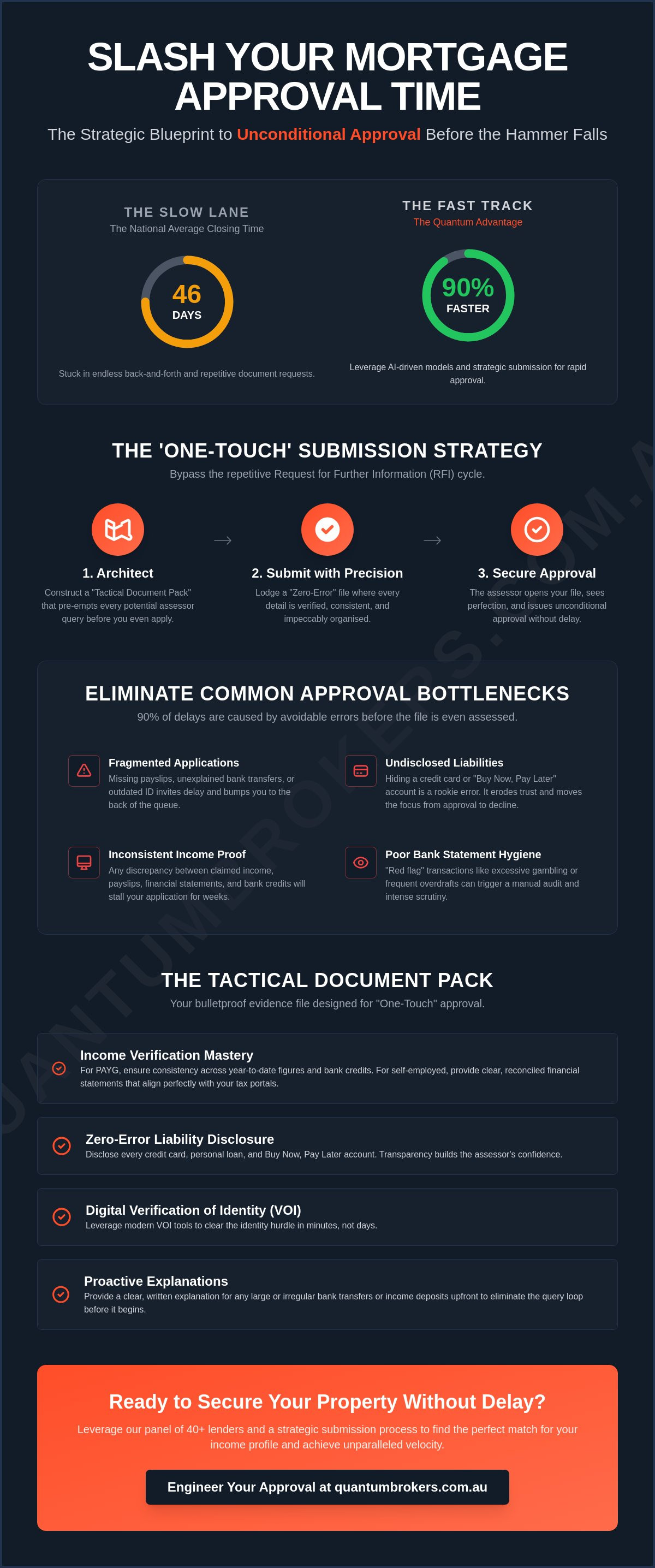
We recognise that the current national average closing time of 46 days is simply too slow for a competitive market. This guide promises to hand you the tactical manoeuvres and financial engineering required to slash those turnaround times. You'll gain a clear roadmap to unconditional approval and learn which lenders are currently using AI-driven models to boost processing speeds by 90 per cent. We're moving past the "hope and pray" method to a strategic blueprint that secures your property before the auction hammer falls.
Key Takeaways
- Identify the internal bank bottlenecks that delay settlement and learn how to position your application for immediate priority.
- Discover how to speed up mortgage approval by architecting a "Tactical Document Pack" that pre-empts every potential assessor query.
- Unlock the "One-Touch" submission strategy to bypass the repetitive Request for Further Information (RFI) cycle and secure unconditional approval faster.
- Leverage a panel of 40+ lenders to find the perfect match for your specific income profile, from standard PAYG to complex self-employed structures.
- Navigate the technical compliance hurdles of NDIS property finance with specialised frameworks designed for rapid turnaround and precision.
The Architecture of Velocity: Why Mortgage Approval Times Vary
Speed isn't a happy accident. It's a byproduct of financial precision. Most borrowers treat the bank like a black box; they throw documents at a portal and hope for the best. This is a tactical failure. Understanding how to speed up mortgage approval requires you to think like a strategic architect. You aren't just applying for a loan; you are constructing a case for immediate approval. When you submit a file that is fragmented or unclear, you invite delay. You must engineer your submission to move through the system without friction.
The "Clean File" principle is your primary weapon. Industry data suggests that 90 per cent of approval delays happen before the assessor even opens the folder. These delays are caused by missing pay slips, unexplained bank transfers, or outdated identification. Every time a lender has to ask for clarification, your file gets bumped to the back of the assessment queue. If you want velocity, you need a submission that answers every question before it is asked. Unconditional approval is the point where the lender is legally committed to the loan.
Conditional vs Unconditional: Knowing the Finish Line
Pre-approval is a tactical signal, not a guarantee of funds. It tells agents you're a serious player, but it doesn't mean the cash is ready. The "Subject to Valuation" trap is where most dreams stall in the 2026 market. If your property type doesn't align with the lender's current risk appetite, your progress hits a wall. You need to manage expectations for settlement periods by aiming for unconditional status from day one. Don't settle for a "maybe" when you can secure a "yes."
The Internal Assessment Queue
Every bank operates on Service Level Agreements (SLAs). These aren't static; they fluctuate weekly based on internal application volumes. While traditional institutions might struggle with a 10-day wait, digital-first lenders are disrupting these windows with near-instant assessments. To bypass the bottleneck, you must understand the mortgage underwriting process and what the credit assessor is actually hunting for in your file. They are looking for clear evidence of capacity and collateral. Provide this in a structured, high-velocity format, and you move straight to the front of the line.
Engineering the Perfect Application: The Tactical Preparation Phase
Submission is the final act, not the first. If you wait until you've found a property to start gathering documents, you've already lost the race. Discovering how to speed up mortgage approval starts with the creation of a Tactical Document Pack. This is a bulletproof evidence file designed to withstand the most rigorous assessment. A fragmented application is a direct invitation for a credit assessor to pick apart your financial life, leading to the dreaded Request for Further Information (RFI) cycle. You want a "One-Touch" approval where the assessor opens your file, sees perfection, and issues the letter.
Income verification mastery is non-negotiable in 2026. For PAYG earners, a simple payslip is no longer the gold standard; lenders now look for consistency across year-to-date figures and bank credits. If you're self-employed, the requirements are even more stringent. You must provide clear, reconciled financial statements that align with your tax portals. Any discrepancy between what you claim and what the data shows will stall your application for weeks. You must also be ruthless with liability disclosure. Hiding a small credit card limit or a "Buy Now, Pay Later" account is a rookie error. Assessors see these on your credit report instantly. When they find an undisclosed debt, they stop looking for reasons to approve you and start looking for reasons to decline you.
The Zero-Error Document Checklist
Precision is your best friend. Leverage digital Verification of Identity (VOI) tools to clear the identity hurdle in minutes rather than days. Your bank statement hygiene must be impeccable. Avoid "red flag" transactions like excessive gambling or frequent overdraft fees that trigger manual audits. In the high-velocity lending environment of 2026, assessors want to see a disciplined financial character. Providing a clear explanation for large bank transfers or irregular income upfront eliminates the query loop before it begins.
Architecting Your Financial Position
Simplicity wins. Consolidate minor debts to streamline your serviceability calculation and present a cleaner profile to the lender. The "Genuine Savings" hurdle remains a common bottleneck; engineer your deposit history to show clear, transparent accumulation over at least three months. Strategic use of home mortgage frameworks ensures your application hits the right desk at the right time. If you are ready to stop guessing and start winning, architecting your next move with a specialist is the smartest tactical play you can make.
Navigating the Lender Panel: Selecting for Velocity and Fit
Selection is the ultimate speed lever. Most Australians default to the Big 4 banks out of habit; however, in the 2026 market, this is often a tactical error. When you understand how to speed up mortgage approval, you realise that the fastest path isn't through a local branch but through a lender whose current appetite matches your specific profile. A major bank might have a 10-day assessment queue, while a non-bank lender on a 40+ lender panel is hungry for new business and ready to issue an approval in 48 hours. You need to target the "Fast-Track" Tier. These are institutions that have invested heavily in automated valuation models (AVMs) and AI-driven credit scoring to eliminate human bottlenecking.
This is where a mortgage broker provides a decisive advantage in discovering how to speed up mortgage approval. We don't just submit applications. We architect them to fit the specific credit policy of the lender most likely to move at pace. Navigating this panel requires deep technical knowledge of which institutions are currently hitting their service level targets and which are drowning in backlogs. By matching your loan profile to the right lender appetite, we ensure you avoid the "No" queue entirely and find the most efficient path to settlement.
Digital Lenders vs Traditional Institutions
The rise of "Neo-Lenders" in 2026 has redefined the industry standard with sub-24-hour approval targets. These players use automated data feeds to verify income and expenses instantly. Their systems are built specifically for modern data standards, meaning they don't get bogged down by the legacy paperwork that hampers older banks. However, traditional institutions still have their place. If you have a complex existing relationship with a major, we can often leverage internal data to bypass certain external verification steps. For specialist scenarios like NDIS property finance or construction, the choice becomes even more granular. You need a lender that understands the specific income modelling of these sectors to avoid a rejection based on policy ignorance.
Valuation Tactics: Skipping the Physical Inspection
Physical valuations are a notorious bottleneck. You can shave five days off your approval time by targeting lenders that utilise AVMs (Automated Valuation Models). These digital assessments provide an instant value based on high-density market data. Generally, LVR thresholds below 80 per cent trigger these desktop valuations in metropolitan areas where property data is abundant. For high-equity borrowers, pre-ordering a valuation is a strategic move that allows us to present a complete, valuation-backed file to the assessor from the first minute. This eliminates the "Subject to Valuation" suspense and moves you straight to an unconditional status without waiting for a valuer to visit the property.
The Zero-Error Blueprint: Eliminating Approval Bottlenecks
Eliminating friction is the final step in your tactical plan. A "One-Touch" submission is the ultimate objective; this is an application so comprehensive that the credit assessor moves from intake to approval without a single query. In the 2026 lending environment, banks have deployed advanced AI to scrape your bank statements, instantly categorising your spending into discretionary and essential buckets. If your data is messy, your approval is slow. Learning how to speed up mortgage approval requires you to master the Household Expenditure Measure (HEM) test by demonstrating disciplined transaction history months before you apply.
The RFI (Request for Further Information) cycle is where momentum goes to die. Every time an assessor hits "pause" to ask about a random $2,000 transfer or an undisclosed Zip account, you lose your spot in the queue. You must pre-empt these doubts by providing a proactive "Letter of Explanation" for any one-off financial events. This level of detail is even more critical when managing the technical hurdles of construction finance, where build-contract nuances can trigger manual reviews. If you are ready to bypass the bank's bureaucracy, secure your fast-track approval with a specialist who knows the system's shortcuts.
The Living Expenses Deep Dive
Precision in your transaction history is your greatest asset. Adopt the "Three-Month Rule" by cleaning up your bank statements 90 days before submission. This means minimising "red flag" discretionary spending and ensuring all boarder income or dependent costs are disclosed with surgical accuracy. When the bank's AI sees a clean, predictable spending pattern, it flags your file for an automated fast-track. If you fail this initial digital screen, you are relegated to a manual assessment queue that can add weeks to your timeline.
Technical Mastery: Pre-empting Assessor Doubts
Your credit report must be flawless before it hits the assessor's desk. Forgotten defaults or minor late payments on a utility bill act as digital landmines that can blow up an otherwise perfect deal. An unexplained $500 debt can delay an application by 48 hours while the assessor waits for clarification. By checking your report early and providing context for any anomalies, you maintain the "One-Touch" momentum. This strategic preparation ensures your file is seen as a low-risk, high-velocity asset for the lender.
The Quantum Advantage: Fast-Tracking Complex Lending Scenarios
Complexity is not a valid reason for delay. While traditional banks often relegate "non-standard" applications to a slow-moving manual queue, we treat them as a technical design challenge. Mastering how to speed up mortgage approval for self-employed borrowers or those entering the NDIS space requires a specialist who understands the inner workings of credit policy better than the banks themselves. We don't wait for a "no." We architect a "yes" by selecting lenders whose frameworks are built for innovation rather than rigid box-ticking.
Strategic integration is the key to velocity. Whether you are looking at rural home loans with unique land-size requirements or knock down rebuild finance that demands complex progress payment schedules, the blueprint remains the same. You need a cohesive fast-track plan that pre-empts technical compliance hurdles before they become settlement-killing bottlenecks. This "Expert Fixer" approach is how we secure unconditional approvals where others only find obstacles.
Self-Employed Velocity Strategies
Business owners often face a wall of bureaucracy. We bypass this by utilising "Alt-Doc" or "Low-Doc" pathways for clients who prioritise speed over the absolute lowest rate. In the 2026 market, certain lenders allow us to leverage just one year of tax returns for 24-hour approvals. A precisely drafted accountant’s declaration serves as a high-speed substitute for months of manual income verification. This allows you to move from inquiry to engagement without the typical three-week wait for a bank assessor to understand your profit and loss statement.
Unlocking NDIS Property Finance
NDIS and SDA Property Finance are high-performance investments that require specialised handling. We accelerate these deals by pre-vetting SDA providers to satisfy lender compliance departments instantly. Success in this niche depends on how you model the "Specialist Disability Accommodation" income streams. We present this data in a way that aligns perfectly with lender risk models. Quantum Brokers is the tactical choice for NDIS specialists because we thrive on the technical complexity that causes standard brokers to hesitate.
Architect Your Unconditional Approval Today
Velocity in the 2026 mortgage market isn't a matter of luck. It's the result of precise financial engineering and a refusal to accept the bank's standard timeline. You've seen that the path to success requires a bulletproof Tactical Document Pack and the strategic selection of lenders who prioritise speed. By eliminating the RFI cycle and pre-empting assessor doubts, you move from the back of the queue to the front of the line. Mastering how to speed up mortgage approval is about taking control of the narrative before the bank even opens your file.
At Quantum Brokers, we thrive on the technical challenges that stall traditional providers. We bring an expert "fixer" mentality to every deal, whether you're navigating complex self-employed income or NDIS property finance. With access to over 40 Australian lenders, we don't just find you a loan; we architect a victory. Don't let a slow bank cost you your dream property. Unlock your borrowing power in 24 hours with a Quantum Strategic Assessment. Your future home is waiting; let's secure it with precision.
Frequently Asked Questions
How long does a typical mortgage approval take in 2026?
Most Australian mortgages currently close within 30 to 60 days, with the national average sitting at 46 days as of June 2026. While the pre-approval phase typically lands between 24 and 72 hours, the final unconditional approval depends heavily on valuation speeds and assessor volumes. Choosing a lender with modern AI-driven processing can significantly reduce these windows compared to traditional institutions.
Can I get a same-day mortgage approval in Australia?
Same-day mortgage approval is achievable with specific digital-first lenders that utilise AI-driven credit scoring and automated valuation models. These institutions have reported funding times dropping from days to minutes for certain loan profiles. For traditional banks, same-day outcomes are rare and generally restricted to simple refinancing scenarios with high equity and clean transaction histories.
What is the fastest way to get a pre-approval?
The fastest route to pre-approval is to architect a complete Tactical Document Pack before you engage a lender. By providing reconciled bank statements and using digital Verification of Identity (VOI) tools, you eliminate the manual data entry that causes delays. This preparation allows high-velocity lenders to process your application through automated systems for a result within 24 hours.
Does a mortgage broker make the approval process faster?
A specialist broker accelerates the timeline by selecting a lender whose current service level agreements (SLAs) align with your deadline. We navigate a panel of 40+ lenders to identify which institutions are currently processing files in 48 hours versus those with two-week backlogs. Strategic lender selection is the most effective way to learn how to speed up mortgage approval in a competitive market.
Why is my home loan taking so long to be approved?
Delays are almost always caused by the "Request for Further Information" (RFI) cycle or internal bank bottlenecks. If an assessor finds an unexplained $500 debt or a missing payslip, they will pause your file and move to the next applicant in the queue. Additionally, some major banks experience seasonal volume spikes that can push their manual assessment windows out by several weeks.
What documents do I need to speed up my mortgage application?
You must provide your two most recent payslips, three months of bank statements, and a clear summary of all liabilities, including credit card limits and HECS debts. Self-employed applicants require the most recent year's tax returns and reconciled financial statements. Providing these documents in a high-resolution, digital format allows lender AI to scrape the data instantly, bypassing the need for manual verification.
Will a low credit score slow down my mortgage approval?
A low credit score triggers a manual review, which naturally extends the approval timeline as human assessors must investigate the underlying risk. While high-scoring files move through automated "fast-track" systems, minor defaults or late payments act as digital landmines. You can mitigate this delay by providing a proactive "Letter of Explanation" that addresses credit anomalies before the assessor asks for them.
How does an automated valuation (AVM) speed up the process?
An AVM provides an instant property value based on data algorithms, which can shave five days off your approval by skipping the physical inspection. Lenders typically trigger these for low-LVR applications in metropolitan areas where data is plentiful. By avoiding the need to coordinate an on-site valuer, your file can move to unconditional status immediately after the credit assessment is finalised.


