

Your current home is no longer just a dwelling; it is a strategic landholding waiting for a high-performance upgrade. You want the luxury of a 7-star energy rated masterpiece without sacrificing the postcode you have spent years establishing. We know the frustration. Most homeowners hesitate because the transition to knock down rebuild finance feels like a technical minefield of "As If Complete" valuations and the logistical stress of managing two sets of housing costs. It is a complex puzzle that traditional lenders often fail to solve with the urgency your builder demands.
This guide serves as your strategic blueprint to mastering 2026 construction funding. We will show you how to architect a financial structure that maximises your existing equity and secures a tactical edge, even with the RBA cash rate sitting at 4.35 per cent. You will learn how to transition seamlessly from your current mortgage to a staged construction facility, ensuring your project remains on track and your borrowing power stays fully optimised. It is time to stop viewing finance as a hurdle and start using it as a precision tool to secure the home your family deserves.
Key Takeaways
- Identify why standard mortgages fail during demolition and how to bridge the "security gap" that often causes traditional lenders to stall.
- Master the five critical stages of knock down rebuild finance to ensure you only pay interest on funds as they are drawn down for the build.
- Learn how to strategically deploy land equity to maximise your borrowing power and manage existing debt during the construction phase.
- Execute a "zero-error" approval blueprint by aligning fixed-price contracts and council-approved plans for a fast-tracked bank response.
- Uncover the tactical advantage of niche lenders who offer more flexible construction policies than the Big Four banks.
The Knock Down Rebuild (KDR) Strategy: Why Traditional Mortgages Fail
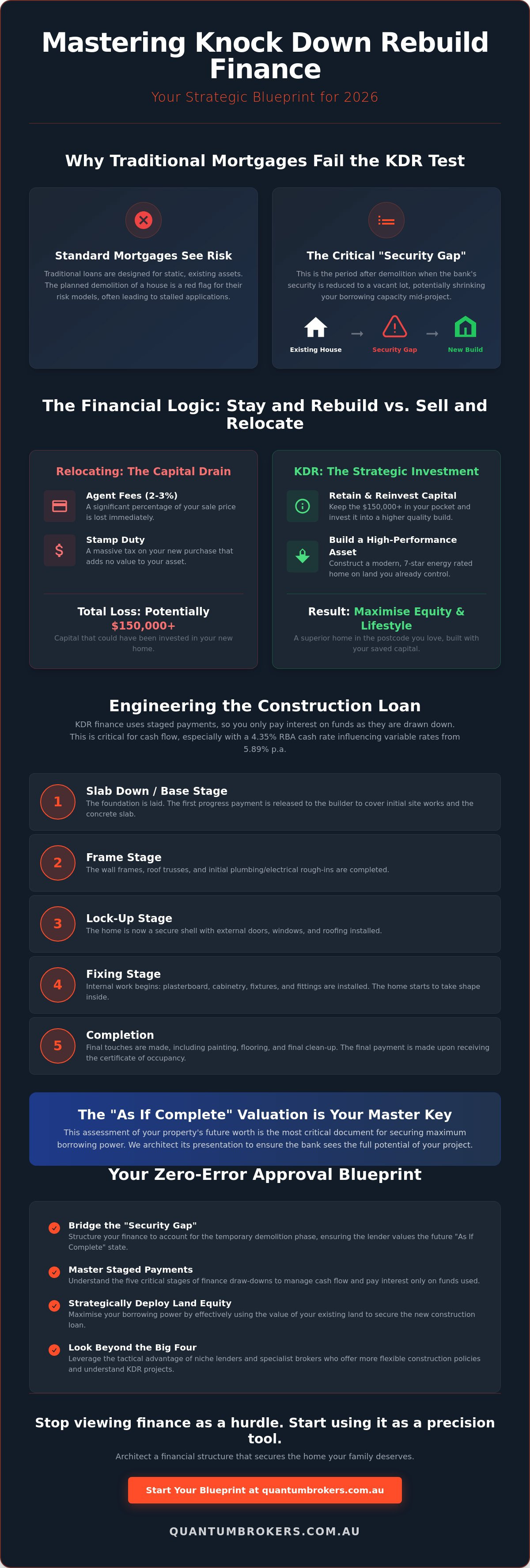
Standard home loans are built for static assets, but knock down rebuild finance is a different beast. It is a specialised construction facility designed to account for the deliberate destruction of the bank's primary security. When you tell a traditional lender you plan to tear down the house they hold a lien against, their risk models often redline. They see a disappearing asset where you see a high-value opportunity. Securing this type of funding isn't about asking for a loan; it's about presenting a risk-mitigated construction schedule that bridges the gap between rubble and a finished residence.
Traditional banks often panic because of the "security gap." This occurs the moment the bulldozer arrives. For a period, the bank's collateral is reduced to a vacant lot, which usually has a lower valuation than the original house and land. Without the right tactical structure, your borrowing capacity can evaporate mid-project. Adopting a self-build strategy requires a "Strategic Architect" mindset. You must engineer the finance before the first brick is removed to ensure the bank values the future "As If Complete" state rather than the temporary hole in the ground.
The financial efficiency of a KDR project far outweighs the alternative of selling and buying elsewhere. In the 2026 Australian market, relocating is a massive capital drain. Between agent fees (often 2 to 3 per cent of the sale price) and the brutal cost of stamp duty on a new purchase, you can easily lose $150,000 before you even move in. A KDR project keeps that capital in your pocket, allowing you to reinvest it directly into the quality of your new build.
The Financial Logic of Staying Put
Relocating in the current market is a gamble. KDR allows you to retain the appreciating land value in a neighbourhood you already know while replacing a depreciating, inefficient structure. For owner-occupiers, it's the fastest path to a 7-star energy rated home. For investors, it's a tactical move to reset the depreciation schedule and significantly increase rental yield. You aren't just building a house; you're architecting a more profitable asset on land you already control.
Why Your Current Bank Might Say No
Lenders often struggle with serviceability during the "double-up" period. They worry about your ability to pay rent for temporary accommodation while servicing a construction loan. Most Big Four banks also use conservative "unimproved land value" assessments that don't reflect the true potential of your project. At Quantum, we know a "no" from a major bank is usually just a lack of tactical imagination. They see a risk; we see a structural design challenge that requires a more sophisticated lending framework.
Engineering the Construction Loan: Staged Payments and Valuation Mastery
Executing a high-performance build requires more than just a talented architect; it demands financial engineering that matches the physical complexity of the project. Unlike a standard mortgage where the full loan amount is disbursed at settlement, knock down rebuild finance operates through a series of progressive draw-downs. This structure is designed to protect both the lender and your capital. You only pay interest on the funds that have actually been released to the builder. If you have only reached the slab stage, you aren't paying interest on the costs of the roof or the final fit-out. With variable construction rates starting from 5.89 per cent p.a. in June 2026, this "interest-only" period is a vital tactical tool for managing your cash flow while you may still be paying for temporary accommodation.
The "As If Complete" valuation is the most critical document in your blueprint. It is a professional assessment of what the property will be worth once the last tile is laid. Because the RBA cash rate currently sits at 4.35 per cent, lenders are scrutinising these valuations with extreme precision. We don't just wait for the bank's valuer to show up. We architect the presentation of your plans, specifications, and local comparable sales to ensure the valuer sees the full future value of your high-spec build. This proactive approach is essential for securing the maximum borrowing power needed to navigate 2026 labour and material cost fluctuations.
The Five Pillars of Progress Payments
Your loan will typically be released in five distinct stages. Each stage requires a signed claim from the builder and, often, an inspection from the bank's valuer to confirm work matches the contract. While researching home improvement financing can provide a baseline for smaller projects, a full KDR requires strict adherence to this sequence:
- Deposit: Usually 5 per cent to cover initial administrative and site costs.
- Slab: Completion of the foundations and plumbing.
- Frame: The skeletal structure of the home is erected and approved.
- Lock-up: The exterior is sealed, including windows, doors, and roofing.
- Final Settlement: The remaining balance is paid upon the issuance of the Occupancy Permit.
A tactical move here is to hold back the final payment until every defect is rectified. We advocate for our clients to ensure the bank does not release the final draw-down until the builder has delivered exactly what was promised in the contract.
Architecting a Winning Valuation
A "valuation shortfall" occurs when the bank's valuer estimates the finished home will be worth less than the combined cost of your land and the building contract. This can stall a project before it starts. To mitigate this, we provide valuers with a comprehensive pack including your fixed-price contract and evidence of recent high-value sales in your suburb. If a shortfall persists, our specialist construction loan brokers can pivot to niche lenders who use more favourable valuation methodologies than the Big Four. We don't accept a low valuation as the final word; we treat it as a design flaw that needs a strategic fix.
Strategic Debt Structuring: Managing Existing Mortgages and Equity
Managing debt during a project of this scale is a high-stakes engineering task. You aren't just paying a bill; you're balancing two financial worlds. The transition from an existing mortgage to knock down rebuild finance requires a tactical bridge to ensure you don't run out of liquidity mid-demolition. Most homeowners assume they must pay off their current loan before starting, but the most efficient strategy involves leveraging your "paper profit" to fund the initial stages. In many established Australian suburbs, the land value has outpaced the dwelling value so significantly that your equity can often cover the demolition costs and the builder's deposit without you touching your cash reserves.
If you own your land outright, you have a massive strategic advantage. You can unlock maximum leverage for the build, often securing more competitive terms because the bank's risk is lower. However, if you have an existing mortgage, we must architect a refinance that rolls your current debt into a new construction facility. This isn't a standard top-up. It's a total restructure that prioritises your cash flow during the twelve to eighteen months you'll be out of the home. We often utilise a high-performance offset account strategy. By keeping your construction funds in an offset account, you maintain maximum liquidity and only pay interest on the net balance, keeping your monthly outgoings as lean as possible.
The Refinance Playbook
Your current lender might have been great for a standard thirty-year mortgage, but they may lack the tactical imagination required for a KDR. If their construction desk is slow or their valuation models are conservative, it's time to switch. We look for lenders who allow debt consolidation to improve your serviceability before the application goes in. Securing the right foundational structure is vital; you can learn more about these principles in our guide to Home Mortgage Australia. A well-timed refinance can unlock the capital needed to meet builder timelines without the stress of a "no" from a Big Four bank.
Managing the "Double-Housing" Cash Flow
The biggest stressor in any rebuild is the "double-up" period where you're paying for temporary rent while servicing a mortgage on a house that no longer exists. Your true borrowing power must be calculated with this reality in mind. To solve this, we explore "Capitalised Interest" options with specific lenders. This allows you to add the interest payments to the loan balance during the build, preserving your daily cash flow for rent and living expenses. Unlike a standard redraw facility, which can be restrictive, a strategically managed construction loan with an offset account gives you the flexibility to navigate 2026's economic shifts without compromising your project's momentum.
The Approval Blueprint: Navigating Technical Requirements for KDR Finance
While amateur renovators complain on internet forums about paperwork nightmares, strategic homeowners treat the application process as a precision strike. Approval for knock down rebuild finance is not a lottery; it is the result of a "Zero-Error" documentation pack that leaves no room for bank hesitation. In the 2026 lending environment, banks are hypersensitive to the National Construction Code (NCC) 2025 transition. From May 2026, new builds must meet a mandatory 7-star energy rating. If your plans and specifications don't explicitly document these requirements, your finance will stall before the first shovel hits the dirt. We ensure your technical submission is bulletproof from day one.
The bank isn't just lending to you; they're effectively partnering with the person swinging the hammer. This is why the "Builder Review" is a non-negotiable part of the process. Lenders will scrutinise your builder’s financial solvency, licence history, and current insurance policies. If a builder is over-leveraged or has a history of project delays, the bank may reject the security regardless of your personal income. Timing your strike is also vital. You should submit your finance application the moment you have council-approved plans (DA or CDC) but before you authorise the demolition of your existing asset. This ensures your "As If Complete" valuation is based on the most current market data.
The Fixed-Price Contract Mandate
Banks loathe "cost-plus" contracts because they represent an open-ended risk. To secure approval, you must present a fixed-price building contract. We help you negotiate lender-friendly agreements that minimise "Prime Cost" (PC) items and "Provisional Sums" (PS). These are essentially budget placeholders for items like cabinetry or excavation that can blow out during construction. A high-performance contract locks these figures down, giving the bank the certainty they need to hit the "approve" button. You must also ensure the Home Building Compensation Fund (HBCF) insurance is active and covers the full contract value to meet mandatory compliance standards.
Self-Employed and Complex Income Tactics
Traditional banks often struggle with self-employed borrowers or those with complex income streams, especially if 2026 tax returns aren't yet finalised. We architect alternative income solutions, using "low-doc" frameworks or business bank statements to verify your serviceability. If your new build includes a secondary dwelling or is designed for NDIS property finance, we use that future rental income to boost your borrowing capacity today. Don't wait for a bank to tell you "no" based on a rigid checklist. Our team provides a 24-hour borrowing power assessment so you can sign your builder with total confidence and move your project into the demolition phase without delay.
Beyond the Big Four: Why Tactical Broking Secures the KDR Edge
The major banks are built for volume, not complexity. When it comes to knock down rebuild finance, their "one size fits all" approach often results in conservative valuations or restrictive serviceability tests that don't account for the unique equity position of a KDR project. Niche lenders and non-bank institutions frequently offer the tactical edge you need. These players often have specialised policies for higher land-to-value ratios and more progressive draw-down schedules. Accessing a panel of over 40 lenders allows us to match your specific project architecture with the institution that has the highest appetite for your build type.
We act as your fierce advocate throughout the entire construction journey. The relationship between the valuer, the builder, and the bank is often fraught with friction. A builder wants payment immediately upon reaching a milestone; a bank valuer wants to see every nail in place before releasing a cent. We navigate this back-and-forth to ensure your project maintains momentum and your builder stays on site. By using high-efficiency processing and our "Loan Machine" methodology, we bypass the bureaucratic delays that plague standard applications. For a deeper dive into the total project lifecycle, consult our guide on Construction Finance.
The Quantum Advantage in 2026
Our track record is built on securing "impossible" approvals for self-employed directors and NDIS investors who have been turned away by the majors. Before your application ever hits a lender’s desk, we stress-test it against current 2026 credit criteria. We identify the potential hurdles in your income or your builder’s contract before the bank does. This proactive approach ensures a faster approval. Our national reach means we can architect solutions for knock down rebuild finance across all Australian jurisdictions, ensuring you stay in the neighbourhood you love regardless of local market shifts.
Next Steps: From Blueprint to Breakthrough
Builder prices in 2026 are not static. A free pre-approval is your most powerful negotiation tool to lock in a builder’s price before the next material cost hike. It gives you the authority to move from inquiry to engagement with total certainty. Don't let your project stall at the planning stage because of a lack of financial design. Book a strategic briefing with Zac Hamdan and the Quantum team to unlock your borrowing power today. We don't just find loans; we architect the financial breakthrough your project requires.
Build Your Future on the Ground You Already Own
Mastering the technicalities of staged payments and "As If Complete" valuations is the only way to bridge the gap between your current equity and your future luxury home. You now have the blueprint to navigate 2026's economic shifts, from managing double-housing costs to securing a fixed-price contract that satisfies the bank's strict risk models. Success in this market isn't about luck; it's about the strategic deployment of capital and the precision of your financial design.
Don't let a conservative bank valuation or a lack of tactical imagination stall your project. Securing the right knock down rebuild finance requires a partner who treats your application as a precision engineering task. We provide access to over 40 Australian lenders and specialise in complex and self-employed lending to deliver fast-tracked construction approvals that the Big Four often miss. We thrive on the technical difficulty others avoid.
It's time to stop compromising on your living standards and start architecting your breakthrough. Architect Your KDR Finance with Quantum Brokers and take the first step toward the home your family deserves. Your dream postcode is ready for its high-performance upgrade.
Frequently Asked Questions
Can I get a knock down rebuild loan if I still have a mortgage?
Yes, you can. Most projects involve an existing mortgage that we refinance into a single construction facility before the bulldozer arrives. We architect this transition by leveraging your land equity to fund the build, ensuring you don't need a massive cash reserve to start the demolition phase. This strategy rolls your old debt into the new facility for maximum efficiency.
Do I need a 20% deposit for a knock down rebuild project?
Not necessarily. While 20 per cent is the standard benchmark to avoid Lenders Mortgage Insurance, many clients use existing land equity as their deposit. Eligible first home buyers can also access the Home Guarantee Scheme to build with as little as a 5 per cent deposit. We calculate your maximum leverage based on the projected "As If Complete" valuation of the final asset.
What happens if the "As If Complete" valuation is lower than the build cost?
We treat a low valuation as a design flaw that requires a strategic fix. If the figure falls short, we provide the valuer with updated comparable sales or pivot your application to niche lenders with more favourable valuation models. Our goal is to ensure your knock down rebuild finance matches your builder's contract price to avoid any out-of-pocket shortfalls.
How long does it take to get finance approved for a KDR?
A "Zero-Error" application can see initial borrowing power assessments within 24 hours. Formal approval typically takes two to three weeks once you have council-approved plans and a fixed-price contract in hand. We fast-track this process by managing the back-and-forth between the lender and the valuer to ensure your funding is ready before your builder's commencement date.
Can I use a first home buyer grant for a knock down rebuild?
Yes, eligible first home buyers can apply state-based grants to a KDR project. For instance, the Queensland grant offers $30,000 for contracts signed before June 30, 2026. These funds are usually released at the slab stage of construction. We integrate these grants into your overall funding strategy to reduce your total debt and improve your initial equity position.
What is the difference between a standard home loan and a construction loan?
A standard loan provides a lump sum at settlement, while a construction loan releases funds in five progressive stages. You only pay interest on the money that has actually been drawn down, which is a vital cash-flow tactic during the build. This interest-only period keeps your outgoings lean while you are paying for temporary accommodation during the 12-month construction program.
Can I manage the build myself as an owner-builder and still get finance?
Owner-builder finance is high-risk and rejected by most major Australian banks in 2026. We generally advise against this path unless you have significant cash reserves or a licensed builder as a partner. Banks demand the certainty of a fixed-price contract from a registered builder to mitigate their risk and ensure the project meets the latest National Construction Code standards.
What happens to my current mortgage when the house is demolished?
Your current mortgage is rolled into the new knock down rebuild finance facility before the demolition begins. The bank must be notified of the demolition because they hold a lien against the original structure. We architect this transition to ensure your credit remains intact and your funding stays secure throughout the "security gap" period while the land is vacant.


