

Your ABN isn't a red flag; it's a strategic asset that most major banks simply don't know how to value. You've likely been told that your high-earning contract role is "unstable" by a lender who can't see past a standard PAYG payslip. It's a common frustration to be penalised for the professional flexibility that drives your income. Getting a mortgage on a contract job in Australia shouldn't feel like a gamble, yet many contractors live in fear of a rejection that could bruise their credit score for years.
We're here to dismantle that barrier. This 2026 tactical blueprint provides the strategic framework you need to secure a home loan as a contractor, even if the big banks have already said no. You'll discover how to architect an application that highlights your financial strength rather than hiding it. We'll preview the specific lenders who favour contract structures and show you how to lock in a competitive interest rate without paying a "contractor tax." It's time to stop asking for permission and start engineering your path to approval.
Key Takeaways
- Shift the focus from "permanent" job titles to industry tenure to satisfy lender stability requirements.
- Master the strategic framework for getting a mortgage on a contract job in Australia by identifying lenders with specific contractor "sweet spots."
- Determine whether your PAYG or ABN structure offers the most efficient path to a competitive interest rate.
- Audit your living expenses to eliminate lifestyle friction and architect a zero-error application.
- Access a panel of 40+ lenders to find the specific policy frameworks that reward your high-income contract status.
The Myth of the 'Permanent' Requirement: Why Contractors Can Win
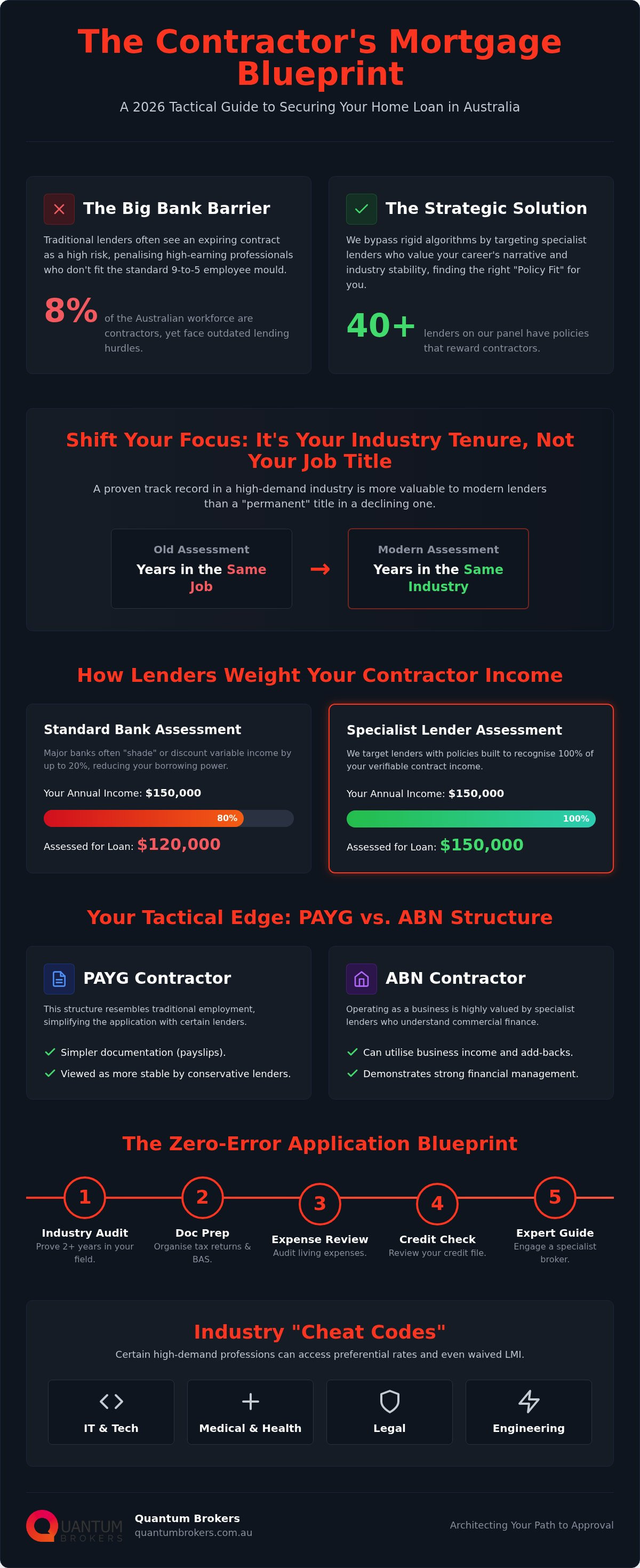
The "permanent" employment requirement is a relic of 20th-century banking. In the modern Australian economy, eight per cent of the workforce now operates as contractors, yet traditional banks still treat this high-performance demographic with suspicion. A "contractor mortgage" in 2026 isn't a separate financial product. It's a strategic alignment where your specific income structure meets a lender's unique policy framework. While a big bank might see an expiring contract as a risk, a specialist lender sees a high-demand professional with a history of consistent billings.
Getting a mortgage on a contract job in Australia requires moving past the standard "no" from retail bank branches. They rely on rigid algorithms designed for 9-to-5 employees. We focus on a "Strategic Yes." This involves identifying the specific "Policy Fit" between your ABN or PAYG contract and a lender's appetite for your industry. A mortgage is a massive commitment; you shouldn't be penalised for having a more modern, flexible career path.
With the Australian unemployment rate sitting at 4.5% in early 2026, the competition for talent is fierce. Lenders recognise that the best talent often chooses to contract for higher rates and better conditions. We leverage this reality to secure approvals that standard bank managers would dismiss instantly. It's about architecting a case that proves your income is intentional, not incidental.
Stability vs. Job Title: What Lenders Actually See
Stability is no longer defined by a job title. Lenders now quantify risk through historical continuity and industry demand. A high-earning IT contractor with a six-month rolling contract is often viewed as more stable than a junior permanent clerk in a declining sector. If you work in "Essential Services" like nursing or specialised engineering, your path to approval is often fast-tracked. Lenders look for the "Narrative" of your career. They want to see that when one contract ends, your skills ensure the next one begins immediately.
The Shift in Australian Lending Landscapes for 2026
The 2026 regulatory environment has forced Australian lenders to become more nuanced. The old "one-size-fits-all" assessment is failing. This has led to a surge in non-bank lenders who specialise in contract employment. These institutions don't just look at the current contract expiry date; they look at your tax returns, BAS statements, and industry tenure. Your current bank is often the worst place to start because they are bound by legacy systems. Specialist brokers now bypass these hurdles by architecting applications for lenders who actually value your professional autonomy.
Decoding Lender Assessment: How Your Income is Weighted
Lenders don't just look at your daily rate. They look at the architecture of your earnings. Most retail banks use a "shading" system that automatically discounts variable income by up to 20%. This means your $150,000 contract might only be assessed as $120,000 for serviceability purposes. Getting a mortgage on a contract job in Australia requires a strategy that forces lenders to recognise 100% of your earning power. We achieve this by targeting lenders whose policy frameworks are built for professional contractors rather than generic salaried staff.
The "Continuity Rule" is your most powerful lever. While a standard bank manager wants to see two years in the same job, specialist lenders prioritising contract work look for two years in the same industry. They value historical consistency over the specific name on your contract. If you have a deep track record in a high-demand sector, your current contract's remaining term becomes less of a hurdle. In fact, for certain "Cheat Code" industries like IT, Medical, or Legal, some lenders will waive Lenders Mortgage Insurance (LMI) or offer preferential rates even on a contract basis.
The 'Time in Job' Framework
Lender tiers are typically broken into 3-month, 6-month, and 12-month brackets. However, the "1-day rule" exists for those with significant industry experience. If you've just started a new contract but have five years of continuous history in the same field, we can often secure an approval before your first invoice is even paid. For those in hybrid roles or moving between structures, understanding the nuances of Home Loans for Casual Employees can provide additional tactical options for your application.
Weighting Variable Income and Overtime
Lenders are naturally sceptical of bonuses and irregular hours. They want to see a "Tax Invoice" trail that proves stability. When determining if you are an employee or contractor, the ATO looks at control and risk, but lenders look at the reliability of the cash flow. We ensure your ABN income is presented through a "Strategic Architect" lens, using Business Activity Statements (BAS) and tax returns to prove that your "variable" income is actually a consistent high-performance result. If your bank is currently shading your hard-earned overtime, it's time to audit your borrowing power with a specialist who understands the math of contracting.
PAYG vs. ABN Contracting: Choosing Your Tactical Edge
Your tax structure is the primary blueprint for your loan approval. Lenders categorise risk based on how you receive your pay, and choosing the wrong structure for your application can lead to an immediate decline. While most articles treat all contractors as a single high-risk group, we distinguish between PAYG and ABN structures to find your specific tactical advantage. Getting a mortgage on a contract job in Australia is significantly smoother when you align your employment type with a lender's specific "sweet spot."
The distinction is simple but critical. PAYG contractors are often viewed as "quasi-permanent" staff by specialist lenders. Conversely, ABN contractors are assessed under self-employed frameworks, which require a more robust documentation trail. In 2026, the "Gold Standard" for ABN holders has shifted; while banks once demanded two years of tax returns, many now accept just 12 months of ABN history if your industry tenure is strong. Whether you operate as a sole trader or through a proprietary limited company, the goal is to present a narrative of financial mastery rather than just a list of invoices.
The PAYG Contractor Advantage
PAYG contracting is the path of least resistance for high-LVR loans. Lenders favour this structure because your tax is withheld at the source, mirroring a standard salary. We focus on documenting your "rolling" contract history to prove continuity. If your contract has been renewed at least once, many lenders will treat you identically to a permanent employee. We ensure your leave loading and superannuation are calculated correctly to maximise your assessable income, preventing the bank from underestimating your true borrowing power.
The ABN Strategic Blueprint
ABN contracting offers more complexity but greater opportunities for income optimisation. For independent contractors, we navigate the choice between low-doc and full-doc options. A "Strategic Architect" approach involves using "add-backs" to boost your serviceability. We identify one-off expenses, depreciation, or non-recurring costs that the bank's standard algorithm would normally count against you. By adding these back into your profit, we architect a higher borrowing capacity. For a deeper dive into these technical manoeuvres, our Self-Employed Home Loans Guide outlines the exact documentation required to win. We don't just submit your tax returns; we engineer them to meet the lender's specific appetite for independent risk.
The Zero-Error Blueprint: Preparing Your Application
Execution is where most contractor applications fail. You've identified the right lender and structure, but if your submission contains friction, the bank's algorithm will default to a "No." Getting a mortgage on a contract job in Australia requires a zero-error approach. We start by auditing your employment history to build "The Narrative." This isn't just a list of dates; it's a demonstration of increasing demand for your skills. Simultaneously, you must cleanse your living expenses. Lenders in 2026 are forensic. They will scrutinise every subscription and UberEats order to determine your true discretionary spend. If your bank statements show lifestyle leakage, we fix it before the assessor sees it.
Securing a "Letter of Exclusivity" or a formal contract extension confirmation is your next tactical move. This document bridges the gap between your current contract expiry and the lender's requirement for ongoing stability. When architecting your deposit, consider the LMI implications. While a 20% deposit is the gold standard to avoid Lenders Mortgage Insurance, some lenders offer waivers for high-performing contractors in specific sectors. Finally, you must engage a specialist broker to "Pre-Flight" your application. We run your file through the same stress tests the banks use, ensuring we solve problems before they become rejections.
The Documentation Masterlist
Your payslips are only the beginning. For a contractor, the "Contract of Engagement" is the primary evidence of income reliability. Banks will cross-reference this with your ATO Portals and Notice of Assessments to ensure your declared income matches your tax obligations. Surprisingly, your resume is a critical lending document. It provides the historical continuity that proves you aren't a "new" worker, but a seasoned professional with deep industry tenure. We use it to justify your income stability to credit assessors who may not understand your specific niche.
Mitigating Employment Gaps
Gaps between contracts don't have to be fatal. The "30-Day Rule" is a common benchmark; gaps shorter than a month are often ignored if your industry history is robust. For longer sabbaticals or planned breaks, we use a "Statutory Declaration" to provide context. We frame these periods as intentional career management rather than "unemployment." By architecting this explanation upfront, we prevent the lender from making negative assumptions about your reliability. If you're ready to stop guessing and start building a winning file, book a 24-hour borrowing power calculation with our strategic team today.
Architecting Your Approval with Quantum Brokers
The Big Four banks use a blunt algorithm. It's a binary system: you're either a permanent employee or a high-risk outlier. We reject that premise. At Quantum Brokers, we operate as Strategic Architects rather than simple middlemen. We don't just submit applications; we engineer them to bypass the systemic bias against contractors. With access to 40+ Australian lenders, we identify the specific policy "sweet spot" that matches your unique contract structure. Whether you're an IT specialist or a nursing professional, we align your income with a lender that values your industry tenure over your current job title.
Our expertise extends to the most complex financial structures in the 2026 market. For contractors looking to diversify their portfolio, we specialise in NDIS Property Finance. This requires a sophisticated understanding of both government-backed income streams and contract-based serviceability. We call our speed "Lazer Money." In a competitive property market, waiting weeks for an answer is a failure. We secure approvals in days. We remove the friction, navigate the red tape, and deliver a result that standard brokers simply can't match. Getting a mortgage on a contract job in Australia is no longer a hurdle when your application is architected for success.
Your Tactical Advantage
Our process is designed for high-performance individuals who value efficiency. We move from a 24-hour borrowing power calculation to settlement with surgical precision. We thrive on the "difficult" loans that banks reject because we understand the underlying math of your ABN or PAYG structure. There is no room for hesitation in our approach. You get a direct, evidence-based briefing on your options. No jargon. No excuses. Just the results required to secure your property. We turn the complexity of your employment into a strategic advantage that lenders can't ignore.
Next Steps: Secure Your Pre-Approval
Don't let a generic bank rejection stall your property goals. Your income is a strength, not a weakness. Use our 24-hour borrowing power calculator today to see what's actually possible in the current lending environment. Once you have your data, book a tactical briefing with Zac Hamdan and the team. We will review your specific contract narrative and architect a path to approval that the big banks missed. The market moves fast. You need a partner who moves faster. Unlock Your Borrowing Power Now and take control of your financial future.
Take Command of Your Property Strategy
Your professional autonomy shouldn't be a barrier to home ownership. We've demonstrated that stability is defined by your industry track record; not just a single contract expiry date. Success depends on the architecture of your application; from choosing the right tax structure to building a zero-error narrative. We've dismantled the myth that permanent employment is the only path forward in the 2026 market.
Getting a mortgage on a contract job in Australia is a strategic operation. It requires a partner who thrives on technical complexity and knows exactly where the lender policy "sweet spots" are hidden. We've masterminded approvals for high-performers across 40+ Australian lenders. Don't let a generic "no" from a branch manager dictate your future. It's time to stop guessing and start engineering a result that reflects your true earning power.
Secure Your Tactical Pre-Approval with Quantum Brokers today. We offer a free borrowing power assessment to identify the specific lender framework that rewards your contract status. Your next move starts here. Let's secure your victory.
Frequently Asked Questions
Can I get a mortgage if I’ve only been contracting for 3 months?
Yes. You can secure an approval with limited contract tenure if you have a robust history in the same industry. While major banks often demand six months; we architect applications for lenders who utilise a "1-day rule" for experienced professionals. Continuity of skill is the metric that matters. It's about your career trajectory, not just the start date of your current contract.
Is the interest rate higher for contract workers in Australia?
No. There is no "contractor tax" when you navigate the market correctly. You are entitled to the same competitive interest rates as permanent employees. We bypass lenders who apply risk loadings to contract income. Instead, we target institutions that view your high-earning potential as a strategic strength rather than a liability.
What happens if my contract ends before the mortgage is approved?
Lenders require evidence of ongoing income at the point of settlement. If your contract is nearing its end, you must secure a formal extension or a new offer letter immediately. We often use "Letters of Exclusivity" to bridge these gaps. This ensures the credit assessor remains confident in your financial trajectory throughout the approval process.
Do I need a bigger deposit as a contractor?
A larger deposit isn't a mandatory requirement for contractors. You can still access high-LVR loans with a 5% or 10% deposit. In fact, some high-performing contractors in medical or legal sectors may qualify for Lenders Mortgage Insurance (LMI) waivers. This allows you to secure a property with a smaller upfront capital contribution without being penalised.
Can I get a home loan as a subcontractor with an ABN?
Yes. Subcontractors are eligible for standard and specialised loan products. While traditional banks might demand two years of tax returns; we access policy "sweet spots" where lenders accept just 12 months of ABN history. This is a critical tactical advantage when getting a mortgage on a contract job in Australia as an independent worker.
Will a history of employment gaps stop me from getting a loan?
Gaps are only a red flag if they lack context. We frame sabbaticals or breaks between contracts as intentional career management through Statutory Declarations. As long as you show a consistent return to high-demand roles, lenders will typically focus on your overall industry tenure. They prioritise your ability to generate income over short periods of planned downtime.
Can I use the First Home Buyers Grant while on a contract job?
Contract status has no impact on your eligibility for government assistance. You can still access the First Home Owner Grant and the Home Guarantee Scheme provided you meet the property value and residency requirements. Your contract income is simply the tool used to service the debt. It doesn't disqualify you from receiving the grant itself.
How does being a PAYG contractor differ from being a permanent employee for a loan?
PAYG contractors are often treated as "quasi-permanent" staff by specialist lenders. The primary difference is how the bank assesses income stability. We mitigate the perceived risk of a fixed-term contract by documenting your history of rolling renewals and consistent superannuation contributions. This ensures the lender views your income as reliable and recurring rather than temporary.


