

Your performance bonus isn't just a reward for a job well done; it's a high-leverage asset that most big four banks are too rigid to properly engineer into your borrowing capacity. It's incredibly frustrating to see a lender "shade" your hard-earned income by 20% or even 50% simply because they don't understand your commission structure. You've earned that capital, yet standard assessment models often treat your success as a liability. We know the frustration of being told "no" by a bank that refuses to look past a basic salary slip.
This tactical blueprint will show you how to architect your home loan to ensure 100% of your performance-based pay is recognised by the right Australian lenders. By using bonus income for mortgage application success, you can secure a significantly higher loan amount and fast-track your approval. We'll preview the specific credit policies currently favouring high earners and explain how to bypass the restrictive two-year history requirements that stall most applications in 2026. This is about moving beyond "assistance" and into the strategic design of a winning application.
Key Takeaways
- Stop accepting the "Big Four" standard of shading your income and learn to treat your performance pay as a core strategic asset.
- Discover the specific lender frameworks that allow for 100% recognition when using bonus income for mortgage application assessments.
- Understand why the rigid two-year history requirement is often negotiable for high-earners with the right documentation blueprint.
- Identify the "Sweet Spot" lenders, including non-bank specialists and credit unions, who offer aggressive credit policies for professional bonus structures.
- Master the employer letter requirements and audit steps needed to architect a high-leverage application that maximises your borrowing capacity.
The Tactical Advantage: Why Using Bonus Income for Mortgage Applications Matters
In the high-stakes environment of 2026 property acquisition, your performance-based pay shouldn't be treated as a secondary thought. Most traditional lenders view discretionary bonuses with deep suspicion. They see volatility where we see capital. Using bonus income for mortgage application purposes is often the difference between securing a premium asset in a blue-chip suburb or settling for a compromise. The "Standard Bank Approach" relies on rigid, automated algorithms that penalise anyone whose income doesn't arrive in 26 identical instalments.
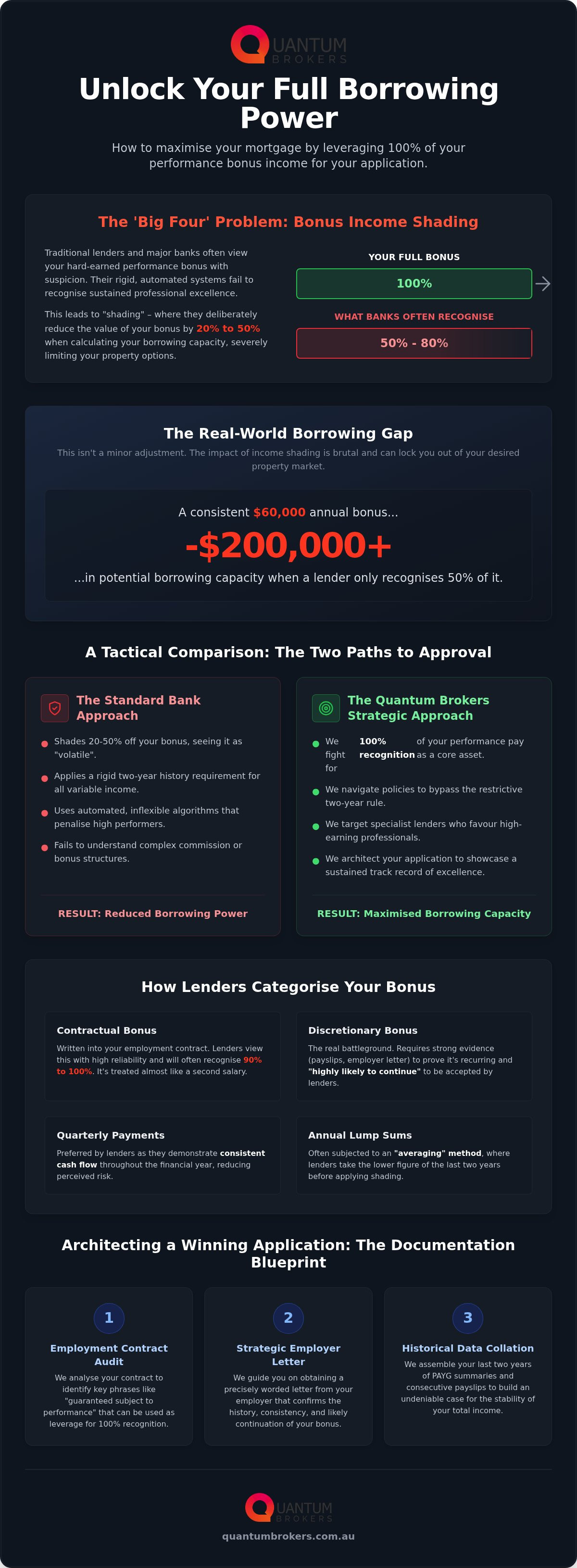
High-performance earners are frequently sidelined by these automated systems. These platforms lack the nuance to distinguish between a one-off windfall and a sustained track record of professional excellence. At Quantum Brokers, we reject this mediocrity. We view the mortgage underwriting process as a field of strategic negotiation rather than a simple checklist. While the Big Four might only recognise 50% to 80% of your performance pay, we architect your application to target lenders who see the full value of your total remuneration package.
The Borrowing Power Gap
The impact of "shading" is brutal. Shaded income is the percentage reduction lenders apply to variable pay to mitigate perceived risk. Imagine you earn a consistent $60,000 annual bonus. A conservative lender counting only 50% of that ($30,000) might slash your borrowing capacity by $200,000 or more. This artificial limitation forces you into lower-tier property markets and restricts your investment potential. By contrast, a strategic application that secures 100% recognition instantly expands your purchase budget. It changes the conversation from "what can I afford?" to "which investment will yield the highest growth?"
Why 2026 Lenders are Evolving
The Australian market is shifting. In sectors like tech, medical, and finance, performance-based pay is now the industry standard. Forward-thinking lenders are finally waking up to this reality, but accessing these specific policies requires technical mastery. We monitor over 40 Australian lenders to identify those who have scrapped the antiquated "two-year rule" in favour of more dynamic assessments. We don't just find you a loan; we design a financial structure that respects your actual earning power. This isn't just about getting an approval. It's about winning in a competitive market by leveraging every dollar you earn.
How Australian Lenders Categorise Your Bonus Income
Lender assessment isn't a neutral process. It's a rigid categorisation exercise where your income is dismantled and rebuilt according to internal risk appetite. When you're using bonus income for mortgage application purposes, the bank first determines if your pay is "contractual" or "discretionary." This distinction is the primary pivot point for your borrowing capacity. While a standard Australian government guide to home loans provides a broad overview of affordability, it rarely touches on the technical nuances of how performance pay is weighted in 2026.
Industry-specific policies also play a massive role. A medical specialist receiving a productivity bonus is viewed with far more leniency than a corporate sales professional on a high-commission structure. Lenders often have "white-list" professions where they're willing to waive standard restrictive policies. We navigate these internal frameworks to ensure your specific career trajectory is used as leverage rather than a hurdle.
Contractual vs. Discretionary: The Credit Policy Divide
If your bonus is written into your employment contract as a guaranteed performance incentive, lenders view it with 90% to 100% reliability. It's essentially treated as base salary 2.0. Discretionary bonuses are the real battleground. To get these recognised, you must provide evidence that the payment is recurring and "highly likely to continue." This typically requires a combination of historical PAYG data and a strategically drafted employer letter. A tactical tip: audit your employment contract before you apply. If your bonus is described as "guaranteed subject to performance," we can often argue for 100% recognition even with conservative lenders.
Frequency and Consistency Metrics
The rhythm of your pay matters as much as the amount. Quarterly bonuses are preferred over annual lump sums because they demonstrate consistent cash flow throughout the financial year. Most lenders use an "averaging" method, taking the lower of the last two years' bonus figures and then applying a 20% haircut. However, we specialise in finding lenders who look at the most recent 12 months if your income is on an upward trend. Using bonus income for mortgage application strategies becomes even more effective when we can prove your new role follows a similar track record in the same industry.
The "two-year rule" is frequently cited as a hard limit by the Big Four, but it's often negotiable. If you've recently moved to a similar high-performance role, we can architect a case based on industry experience and historical earning power. If you're ready to see how your total package stacks up, a strategic borrowing power analysis is the most effective way to identify your true ceiling before you start your property search.
Lender Policy Breakdown: 80% Rule vs. 100% Recognition
Most borrowers fixate on the lowest advertised interest rate. This is a fundamental tactical error. In the high-stakes property market of 2026, the real battle is won or lost on credit policy, not a few basis points. If a lender offers a headline rate of 5.99% but shades your performance pay by 50%, your borrowing capacity is effectively crippled. When you are using bonus income for mortgage application assessments, you must prioritise lenders who recognise the full weight of your earnings. We don't just look for a loan; we identify the specific credit appetite that aligns with your income structure.
Tier 1 Lenders and the 80% Shading
The Big Four and other major institutions typically default to a conservative 80% recognition of discretionary bonuses. They view variable income through a lens of risk mitigation rather than potential. This "shading" doesn't just reduce your perceived income; it aggressively tightens your Debt-to-Income (DTI) ratio. For high earners, hitting a DTI ceiling of 6 or 7 times income happens much faster when 20% of your bonus is ignored. Our Home Mortgage Australia: The 2026 Strategic Guide details how these institutional barriers can be bypassed through superior application architecture.
Niche Lenders and 100% Recognition Strategies
The "Sweet Spot" in 2026 lies with non-bank lenders and specific credit unions that specialise in professional high-earner packages. These players often waive shading for specific sectors, such as medical, legal, or finance professionals, provided you can demonstrate a consistent track record. Understanding the nuances of home loan eligibility criteria is essential here. Some lenders will recognise 100% of your bonus if it has been paid for two consecutive years, while others may accept 100% after just 12 months if the employer letter is sufficiently robust.
Choosing a niche lender might mean a marginally higher interest rate, perhaps 0.10% or 0.15% above a Big Four offer. However, the trade-off is a massive increase in borrowing power. This leverage allows you to secure a superior asset that outperforms the minor cost of the higher rate. At Quantum Brokers, we navigate a panel of 40+ lenders to find these specific policy wins. We also manage the invisible hurdle of Lenders Mortgage Insurance (LMI). LMI providers often have stricter overlays than the banks themselves; we ensure your application is directed to lenders with internal delegations that prevent an insurer from vetoing your approval. Using bonus income for mortgage application success requires this level of technical precision to ensure 100% of your capital is working for you.
Architecting Your Application: The Documentation Blueprint
Approval is not a matter of luck; it is a result of meticulous engineering. Most applicants fail because they treat their documentation as a passive record rather than a persuasive argument. When using bonus income for mortgage application purposes, you must present a narrative of consistency and reliability that satisfies the specific credit appetite of your chosen lender. We don't just submit files; we architect a case that forces a "yes" from the credit assessor. This blueprint outlines the tactical steps required to secure 100% recognition of your performance pay.
Execution begins with a five-step strategic audit:
- Step 1: Audit your PAYG summaries and tax returns for the last two financial years to identify your lowest earning baseline.
- Step 2: Secure a high-impact employer letter that explicitly defines the nature of your bonus.
- Step 3: Map your income timeline against your property purchase goals to ensure your application hits the lender's desk at the peak of your year-to-date (YTD) earnings.
- Step 4: Execute a preliminary borrowing power assessment using our internal policy filters.
- Step 5: Select the specific lender whose 2026 policy framework matches your unique income structure.
The "Bulletproof" Employer Letter
A generic employment letter is a liability. To ensure your bonus is treated as core income, your employer must include three specific phrases: "performance-based," "regular and recurring," and "highly likely to continue." These markers distinguish your pay from volatile overtime or one-off allowances, which lenders often discount entirely. If you have recently changed firms but stayed within the same industry, the letter must also highlight your continuous track record of performance. We provide our clients with specific templates to ensure their HR departments provide the exact data credit assessors require.
Tax Returns and PAYG Mastery
Consistency is the foundation of credit confidence. Your payslips must align perfectly with your YTD figures and historical tax returns. If you had a "bonus dip" year due to market fluctuations or personal leave, we don't ignore it. We provide the necessary context to prove the dip was an anomaly rather than a trend. This level of detail is what separates a successful high-leverage application from a standard rejection. Many professional earners believe their irregular income makes them "complex," but even home loans for casual employees can be secured when the documentation is engineered correctly.
Don't leave your borrowing capacity to chance. Identifying your true ceiling starts with a technical review of your current earnings. You can begin this process immediately by using our 24-hour borrowing power calculator to see how much of your bonus income can be unlocked in the current market.
Beyond the Base Salary: Why Strategic Broking Wins
Traditional mortgage brokers act as simple intermediaries; Quantum Brokers operates as a Strategic Architect. We don't just facilitate transactions. We engineer financial victories for high-performance earners who have been sidelined by institutional rigidity. Using bonus income for mortgage application purposes is a technical challenge that requires more than a standard submission. It demands a deep understanding of the internal credit appetites across 40+ Australian lenders. We specialise in turning a frustrating "no" from a Big Four bank into a tactical "yes" by identifying the specific policy niches that others overlook.
The synergy between performance-based pay and investment property structuring is where we deliver maximum leverage. Your bonus isn't just extra cash; it's the foundation for high-yield acquisition. When we architect your loan, we look beyond the immediate approval to ensure your debt structure supports long-term wealth creation. We thrive on difficulty. Whether you're navigating complex corporate commissions or irregular executive incentives, our role is to ensure every dollar you earn is recognised at its full value.
Complex Scenarios: NDIS and Self-Employed Integration
Performance pay isn't limited to PAYG employees. We solve the "Self-Employed + Bonus" puzzle for business owners who take variable dividends or drawings rather than a standard salary. Traditional banks often miscategorise these payments as volatile. We re-engineer this narrative to prove consistency and reliability. This strategic positioning is particularly potent when targeting high-yield assets. For instance, our NDIS Property Finance Specialist Australia: The 2026 Blueprint explains how variable income can be harnessed to qualify for specialised government-backed housing investments. We bridge the gap between your complex income and the rigid requirements of NDIS lending frameworks.
Your Next Tactical Move
The 2026 property market moves too fast for hesitation. A 24-hour borrowing power check is your first step toward market dominance. You need to know your true ceiling before you step into an auction room or negotiate a private sale. Engaging with a specialist who understands the mechanics of performance-based pay is more important than visiting a local branch. Technical mastery beats geographic convenience every time. Our Mortgage Broker Near Me: Why Strategic Expertise Beats Proximity guide clarifies why your choice of partner should be based on their ability to navigate complex credit policy rather than their office location. Stop compromising your borrowing capacity. Let's architect a solution that recognises 100% of your hard-earned income.
Command Your Borrowing Capacity with Strategic Architecture
Stop letting institutional rigidity dictate your property ambitions. In 2026, success belongs to those who view their performance pay as a strategic asset rather than a variable risk. We've navigated the shift from 80% shading to 100% recognition by selecting the right policy frameworks and architecting a "bulletproof" documentation blueprint. Using bonus income for mortgage application success is no longer a matter of luck; it's a result of technical mastery and aggressive advocacy.
You deserve a partner who thrives on these complexities. At Quantum Brokers, we access over 40 Australian lenders to find the specific credit policies that favour your high-performance lifestyle. We are specialists in complex and high-performance lending, designed to solve the problems that leave traditional banks confused. Don't wait for a standard rejection. Take the first tactical step with our 24-hour borrowing power turnaround. Architect your successful home loan approval with Quantum Brokers and secure the leverage you've earned. Your next high-yield asset is within reach.
Frequently Asked Questions
Can I use my bonus for a mortgage if I have been in my job for less than two years?
Yes, you can secure an approval with less than two years of tenure by targeting lenders with flexible industry-continuity policies. While the major banks often demand a full 24-month history at a single firm, niche lenders will accept a 12-month track record if you have remained in the same professional sector. We architect your application to prove that your earning capacity is a result of your expertise rather than just your current contract length.
Will lenders accept 100% of my discretionary bonus income in 2026?
Specific Australian lenders will recognise 100% of your performance pay, though the institutional default remains a conservative 80% shading. Success in using bonus income for mortgage application assessments depends on your professional industry and the technical strength of your employer letter. We navigate over 40 lender panels to identify the specific credit appetites that view your discretionary bonuses as core capital rather than a risk factor.
How do banks calculate the average of my bonuses over two years?
Most traditional lenders take the lower of your two most recent annual bonus figures or a simple average of the two years. They then apply a percentage reduction, often 20%, to mitigate perceived volatility. We bypass this rigid calculation by targeting lenders who prioritise your most recent year-to-date (YTD) figures. This strategy ensures your current high-performance trajectory is used to maximise your borrowing power rather than being dragged down by historical averages.
Do I need to pay a higher interest rate if I use my bonus income to qualify?
Not necessarily, but focusing exclusively on the interest rate is a tactical error that can cost you the property. A niche lender might offer a rate 0.15% higher than a Big Four bank but unlock hundreds of thousands in additional borrowing capacity. We balance rate competitiveness with the specific credit policies required to secure your loan. The goal is to find the "Sweet Spot" where you get the leverage you need at a professional market rate.
What happens if my bonus fluctuates significantly year-on-year?
Lenders typically default to the lowest figure when they see significant fluctuations to protect their downside. We solve this by providing a high-impact narrative that explains the variance, such as market cycles or specific project milestones. By providing context through a strategic employer letter, we can often convince credit assessors to use a higher average or focus on the most recent consistent payments rather than the lowest historical dip.
Can commissions and bonuses be used together for a single application?
Yes, these income streams are both categorised as variable pay and can be combined to architect a high-leverage application. We engineer your submission to show the total consistency of your remuneration package. This is a critical move for finance and sales professionals who rely on multiple performance-based streams. Using bonus income for mortgage application success means ensuring every dollar of your commission and performance pay is working toward your total borrowing limit.
Is a contractual bonus viewed more favourably than a performance-based one?
Contractual bonuses are viewed with nearly 100% reliability because they represent a legal obligation from your employer. Performance-based or discretionary bonuses require more documentation to prove they are recurring and "highly likely to continue." We audit your employment contract to identify if your pay can be positioned as "guaranteed subject to performance," which carries significantly more weight with bank credit assessors than a purely discretionary label.
How does bonus income affect my Debt-to-Income (DTI) ratio assessment?
Your bonus income is the primary lever for improving your Debt-to-Income (DTI) ratio, provided the lender doesn't shade it. If a bank ignores 20% of your bonus, your DTI ratio appears artificially high, which can trigger an automated rejection. We direct your application to lenders who recognise 100% of your total earnings. This keeps your DTI within acceptable limits and prevents you from being unfairly penalised by the rigid algorithms used by major institutional lenders.


