
Most banks don't see your dream acreage as a home; they see it as a liability that doesn't fit their rigid metropolitan grid. It's a frustrating reality for many Australians looking to escape the city. Standard rural home loans often trigger automatic rejections the moment you mention a specific postcode or a land size over ten hectares. You've likely already faced the sting of being told your lifestyle hobby farm is a commercial risk requiring an unexpected 40% deposit.
We agree that the traditional lending system is fundamentally flawed for anyone moving beyond the metro fringe. This guide changes the game by showing you how to architect a strategic case for your property that lenders cannot ignore. You'll master the technical definitions of non-metro security and learn how to secure financing despite the 4.35% cash rate and current APRA serviceability buffers. We're moving past the standard rejections to provide a clear roadmap for your tree change. We will cover everything from categorising your land correctly to identifying the specialists who actually want to fund your future.
Key Takeaways
- Identify why banks fear "liquidity risk" and how to reframe your property to bypass standard metropolitan lending filters.
- Master the critical land size thresholds, from 2 to 50+ hectares, that directly dictate your deposit requirements and LVR strategy.
- Avoid the "commercial trap" by correctly categorising your hobby farm as a lifestyle residence rather than a primary production business.
- Verify property eligibility using a technical checklist covering gazetted road access and engineered off-grid power systems.
- Learn how to leverage a strategic network of lenders to secure rural home loans when major institutions refuse to fund.
Navigating the Rural Home Loan Landscape: Why Metro Rules Do Not Apply
Standard banks view the Australian landscape through a narrow metropolitan lens. To them, anything beyond the suburbs is a complication. A rural home loan is not a standard mortgage; it is a specialised credit product architected for properties outside high-density zones. While city lending relies on high-volume, automated approvals, rural financing requires a strategic, individualised approach. The primary hurdle you will face is "Security Acceptability." Lenders don't just look at your income. They scrutinise the land itself to determine if it meets their strict internal frameworks.
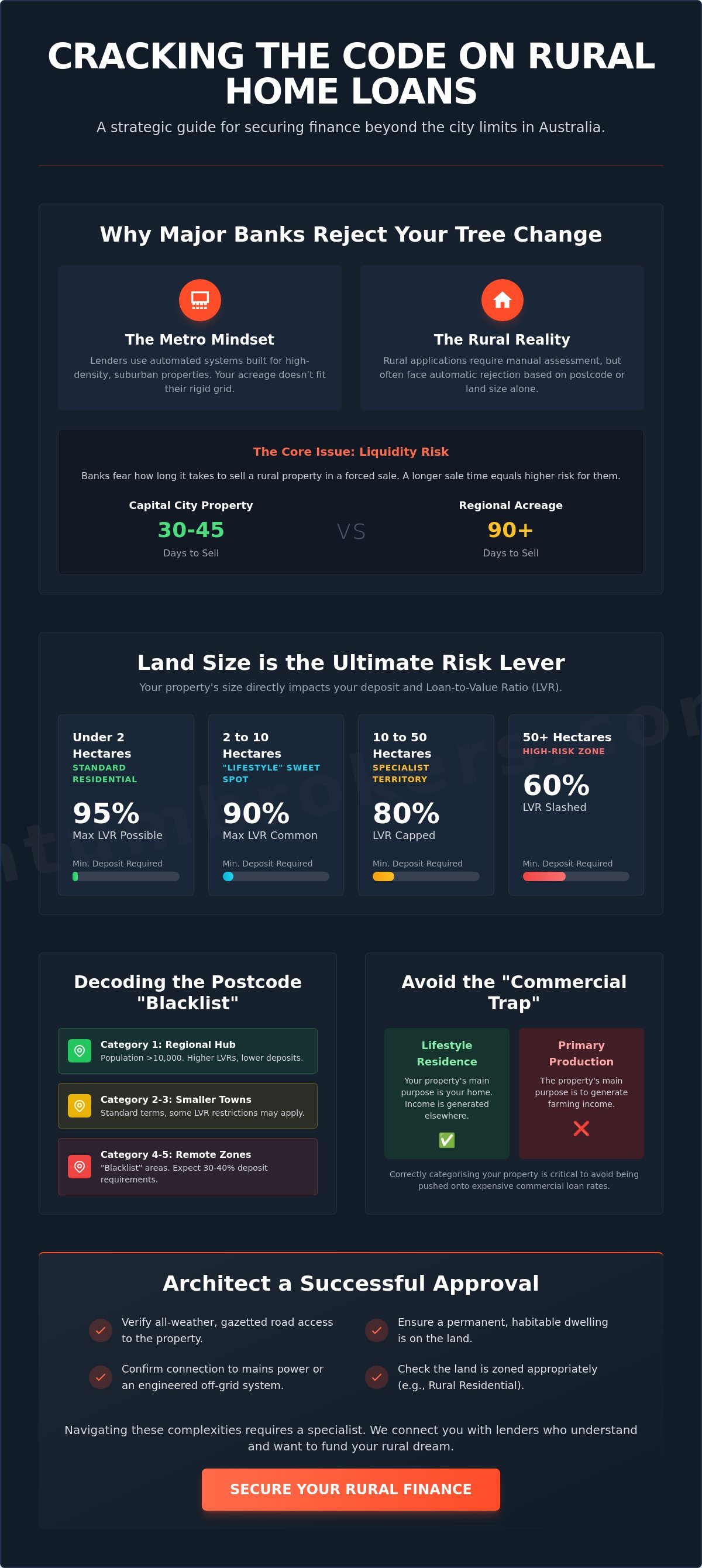
Banks are governed by a fear of "Liquidity Risk." In a capital city, a property usually sells within 30 to 45 days. In regional areas, that timeline often stretches beyond 90 days. If a bank needs to recover funds through a forced sale, they want a fast exit. If the property is too unique or the market is too thin, they see it as a liability rather than an asset. This is why your application often hits a wall before it even reaches a human assessor. You aren't being judged on your ability to pay; you're being judged on the bank's ability to sell your home.
The Tree Change Shift: Rural Demand in 2026
The decentralisation of the Australian workforce has fundamentally redesigned regional property values. By 2026, the traditional "bush block" has evolved into a high-performance lifestyle asset. Modern infrastructure like Starlink has eliminated the digital divide, turning remote acreage into viable professional hubs. Australia remains a major agricultural producer and exporter; however, lenders are slowly recognising that many buyers aren't looking to farm. They are looking for space. This shift has forced a re-evaluation of lender appetites, though the path to approval remains technically complex for those without a specialist broker.
Postcode Restrictions and the "Blacklist" Reality
Lenders use a brutal classification system to manage their geographical exposure. They categorise every postcode in Australia from Category 1 to Category 5. These rankings dictate your maximum Loan-to-Value Ratio (LVR) and your required deposit. A "Category 1 Regional" location is defined as a hub with a population exceeding 10,000 people. These areas typically allow for higher borrowing power and lower deposits. Move into Category 4 or 5, and you face the "Blacklist" reality. In these remote zones, banks may slash your borrowing capacity or demand a 30% to 40% deposit. Understanding these boundaries is the first step in unlocking rural home loans that actually fit your financial strategy.
Decoding Lender Risk: Land Size, Zoning, and the LVR Equation
Size is the ultimate risk lever. While a standard suburban lot fits neatly into a bank's automated valuation model, large-scale acreage requires a manual, high-level assessment. Most rural home loans are governed by strict land size thresholds that dictate your required deposit. If your property is under 2 hectares, it's usually treated like a standard residential home. Once you cross that line, the lending architecture shifts. Lenders typically categorise risk into four distinct buckets:
- Under 2 Hectares: Standard residential terms; up to 95% LVR is often possible.
- 2 to 10 Hectares: The "Lifestyle" sweet spot; many lenders still offer 80% to 90% LVR.
- 10 to 50 Hectares: Specialist territory; LVR often caps at 80% and requires a specific rural valuer.
- 50+ Hectares: High-risk zone; many banks will slash LVR to 60% or push you into commercial rates.
Lenders Mortgage Insurance (LMI) adds another layer of technical difficulty. Even if a bank is comfortable with 40 hectares, their LMI provider might cap their exposure at 20 hectares. This creates a "funding gap" where you might be approved for the loan but rejected by the insurer. For eligible buyers, utilizing the Regional First Home Buyer Guarantee can help bypass some of these hurdles, provided the property meets the specific price and location caps. Before you commit to a purchase, it is vital to align your financing strategy with these land size realities.
The 10-Hectare Rule: A Common Lending Pivot Point
The 10-hectare mark (roughly 25 acres) is where most mainstream lenders stop being flexible. Beyond this point, the bank assumes the property has moved from a "home" to a "holding." They fear that larger blocks are harder to sell quickly, which increases their liquidity risk. To secure a residential interest rate on a block larger than 10 hectares, you must prove the land is for personal enjoyment, not profit. We specialise in architecting these cases to ensure you don't get trapped in a high-interest commercial product simply because you wanted a bigger backyard.
Zoning Secrets: Ensuring Your Land is "Lendable"
Zoning is the silent deal-killer in rural finance. If your land is zoned "Rural Residential" or "Rural Living," most lenders will proceed with a standard home loan. However, if the title says "Primary Production" or "Intensive Farming," standard banks will often retreat. They interpret these labels as a sign that the property is a business, not a residence. You must check your land title for encumbrances or "Section 173" agreements that might restrict how the land is used. Conservative lenders spook easily when they see restrictions that could limit the pool of future buyers.
Hobby Farms vs. Commercial Ag: Categorising Your Property
The distinction between a lifestyle retreat and a commercial enterprise is the single most important pivot point in rural home loans. Lenders define a "Hobby Farm" as a residential property where the land is used for personal enjoyment rather than primary income. If your property produces a profit, even a small one, you risk falling into the "Business Income" trap. Once a bank identifies commercial activity, they will move your application from the residential desk to the commercial department. This shift usually results in higher interest rates, shorter loan terms, and more aggressive repayment schedules.
To secure a residential approval, you must demonstrate that your "farm" is effectively just a large backyard. Highlighting residential upgrades, such as high-quality outdoor blinds from QLD Shade, can help reinforce this lifestyle focus to a valuer. We often advise clients to downplay agricultural infrastructure during the application phase. While a massive machinery shed or a professional-grade irrigation system adds value to you, it signals "commercial intent" to a bank's risk assessor. Valuers are trained to look for signs of primary production. If they see a property dominated by livestock or commercial-scale crops, they will flag it as a business asset. This triggers a different set of lending criteria that can derail a standard tree change strategy.
Income Assessment for the Rural Professional
Moving to the country often involves a change in how you earn. We specialise in how we architect self-employed income to fit the specific requirements of rural lenders. For business owners, the "Lite Doc" advantage is a powerful tool. It allows you to use alternative documentation to prove serviceability without the delays of traditional tax return assessments. Your ABN status is also critical. If you hold an ABN registered for primary production, lenders will assume the property is a commercial venture. We help you navigate these technicalities to ensure your income profile aligns with a residential loan structure.
When the Property Must Pay for Itself
If your goal is a genuine agricultural business, the funding architecture changes completely. Commercial rural lending focuses on the land's productive capacity and your business plan's viability. These loans are often supported by Regional Investment Corporation (RIC) loans, which offer specialised terms for farmers and regional small businesses. Interest rates for these products are typically higher than residential rural home loans because the risk is tied to weather, market prices, and yield. Quantum Brokers maintains a panel of over 40 lenders, including niche providers who specialise in specific land uses. We don't just find a loan; we design a financial structure that supports your long-term operational goals.
Architecting a Successful Approval: The Essential Rural Checklist
Securing rural home loans is a technical exercise in risk mitigation. You aren't just buying land; you're presenting a security case to a bank. If the property fails the basic utility test, the deal dies instantly. Lenders demand a permanent, habitable dwelling as the primary security. Caravans, uncertified "shed-houses," or weekenders without a certificate of occupancy are automatic deal-breakers. We don't wait for the bank to find these flaws. We audit the property against a strict technical checklist before the application is even lodged.
- Access: The property must have all-weather, gazetted road access. Unformed tracks or private easements that aren't legally registered often trigger immediate rejection.
- Power: A connection to the grid is the gold standard. Fully engineered off-grid systems are acceptable only to a handful of specialist lenders who understand the tech.
- Water: While town water is ideal, tank water and bores are the regional norm. However, the storage capacity and delivery system must be fully operational and documented.
- Waste: Your On-site Sewerage Management (OSSM) or septic system must be council-approved. An outdated or uncertified system is a major red flag for conservative risk assessors.
For self-employed buyers or those with complex income, these property hurdles are often secondary to proving serviceability. We specialise in bridging this gap, ensuring your financial profile is as robust as the land you're buying. If you're ready to bypass the standard "no" and move straight to a solution, speak with our strategic architects today.
The "Kerbside" vs. "Full" Valuation Battle
Metro properties often rely on automated desktop assessments. In the bush, you need a local valuer with dirt on their boots. They understand that "comparable sales" are calculated differently when the nearest neighbour is 5 kilometres away. A lack of recent sales within a 10km radius can reduce your LVR by 10%. This is a massive hit to your borrowing power. We counter this by providing lenders with a comprehensive "security brief" that includes local market data to support the valuation from day one.
Essential Infrastructure: Power, Water, and Waste
Infrastructure is about more than just comfort; it's about asset protection. Your Bushfire Attack Level (BAL) rating dictates your insurance costs and, by extension, your loan approval. A high BAL rating can spook conservative banks who fear for the property's longevity. Similarly, lenders look at vegetation cover. They prefer properties that aren't 100% covered in native bush. A requirement for "cleared land" around the dwelling ensures the asset is accessible for emergency services and maintains its value over time. We help you navigate these environmental technicalities to ensure your tree change stays on track.
Unlocking the Bush: How Quantum Brokers Engineers Rural Finance
Most banks operate on a "one size fits all" basis. When you bring them a 40-hectare block with a septic system and a private access road, they don't see opportunity. They see a reason to decline. This "Bank says no" experience is a symptom of rigid metropolitan thinking. We operate differently. We don't just submit applications; we architect the narrative for the credit assessor. By translating the technical complexities of your land into a language the bank understands, we bridge the gap between a rejection and a settlement.
Our strategic advantage lies in our network. We maintain access to over 40 lenders, including specialised regional credit unions and non-bank lenders who thrive on non-metro security. These institutions don't fear the bush. They understand its value. We match your specific property profile with the lender most likely to approve it, ensuring you aren't wasting time with banks that have already "blacklisted" your postcode. This is how we secure rural home loans for clients who have been turned away elsewhere.
Speed is your most valuable currency. In the 2026 regional market, properties move fast. You cannot afford to wait weeks for a standard bank response. We provide fast-track pre-approvals that allow you to negotiate with absolute confidence at a country auction. When you have a Quantum-engineered approval in your pocket, you aren't just another city buyer. You are a serious contender with the financial backing to close the deal.
Why a Tactical Edge Matters in Regional Markets
The regional property boom of 2026 demands a 24-hour turnaround on borrowing power. Standard banks often put rural files in the "too hard" basket, leading to delays that cost you the property. We specialise in these complex files. Whether it's a self-employed income structure or a unique land title, we find the path to "yes." You can start by using our mortgage borrowing calculator to identify your true purchase limit before you head out for inspections.
Your Next Move: Securing Your Rural Future
Don't start driving to inspections without a clear financial strategy. A free pre-approval is the foundation of a successful tree change. It protects your deposit and defines your boundaries. Our principal brokers offer a tailored "Rural Tactical Briefing" to help you understand the specific lending landscape for your target region. We look at the zoning, the land size, and your income to design a winning case. Unlock your rural borrowing power today with Quantum Brokers and take the first step toward your property beyond the fringe.
Secure Your Acreage with Strategic Precision
The path to a life beyond the metro fringe is paved with technical hurdles. Standard banks often use land size or zoning as an excuse to say no. Success requires architecting a narrative that addresses liquidity risk and security acceptability from the start. By mastering the 10-hectare rule and ensuring your property meets the essential infrastructure checklist, you move from being a perceived risk to a viable investment. You don't need a lucky break; you need a high-performance financial strategy that bypasses automated rejections.
We act as specialists in complex and non-metro finance, providing a 24-hour borrowing power assessment to keep you ahead of the market. With access to over 40 Australian lenders, we find the specific niche where your property fits. Don't let a postcode restriction kill your tree change. It's time to leverage expert rural home loans strategies and secure the financing you need to unlock your future. We thrive on the difficulty that stops other brokers in their tracks.
Architect your rural approval - Get a free tactical briefing now. Your property beyond the fringe is waiting, and we have the technical mastery to help you claim it.
Frequently Asked Questions
Can I get a rural home loan with a 5% deposit?
Yes, you can secure a loan with a 5% deposit by utilising the First Home Guarantee scheme. This government-backed initiative allows eligible buyers to bypass the standard 20% deposit requirement without paying Lenders Mortgage Insurance. We architect these applications to ensure your chosen property meets the specific price caps and postcode eligibility required by the scheme's participating lenders.
What is the maximum land size for a standard residential home loan in Australia?
Most major banks cap residential rural home loans at 10 hectares. Once you exceed this limit, mainstream lenders often pivot to commercial terms or demand a significantly higher deposit. We maintain access to specialist lenders who treat properties up to 100 hectares as residential holdings. This allows you to secure standard interest rates on much larger acreage blocks.
Does the property need to be income producing to qualify for a rural loan?
No, the property should not be your primary source of income to qualify for a residential product. Generating significant revenue from the land often forces the application into a commercial category with higher rates. Lenders prefer lifestyle blocks where your primary income is sourced from external professional work. We help you demonstrate that the land is a residence rather than a business asset.
Can I use a rural home loan to build a new house on vacant land?
Yes, you can use a construction loan to build on vacant rural land. The lender assesses the land value and the fixed-price building contract as a single security package. You must ensure the site has legal access and essential services before the first drawdown. We design these financing structures to manage the unique risks of regional builds, ensuring your progress payments remain on schedule.
What happens if my rural property has no town water or sewerage?
Lenders accept on-site sewerage management and tank water provided they are council-approved and fully functional. A property without a town connection is the regional standard, not a defect. However, the valuer will verify the system's capacity and compliance during their inspection. We ensure your documentation proves the property is fully habitable and meets all local health and safety regulations.
Are interest rates higher for rural properties than city houses?
Interest rates for residential rural home loans are typically identical to those for city houses. You only face higher rates if the property's size, zoning, or location forces it into a commercial or specialist category. By architecting your application correctly, we keep you on standard variable or fixed rates. Our goal is to ensure you don't pay a bush premium for your lifestyle choice.
How does a hobby farm classification affect my tax and my mortgage?
A hobby farm classification tells the lender the land is for lifestyle use, which keeps you in a residential loan bracket. From a tax perspective, the ATO distinguishes between a hobby and a business based on your intent to make a profit. We align your mortgage strategy with these definitions. This ensures you maintain residential interest rates while protecting your ability to manage your tax affairs correctly.
What is a gazetted road and why does my lender care about it?
A gazetted road is a public thoroughfare officially recorded in government land records. Lenders require this to ensure legal and physical access to the property at all times. If the only access is via an unformed track or an unregistered easement, the bank fears they couldn't easily sell the asset in a default scenario. We verify the road's status early to prevent a no-access rejection from derailing your settlement.


