

Most big banks aren't looking to help you; they're looking for reasons to "shade" your hard-earned revenue into insignificance. You have built a robust, diversified financial profile, yet the traditional lending system often treats your success like a liability. It is exhausting to face bureaucratic "no" answers simply because your income doesn't fit into a tidy, single-employer box. You know your numbers are strong, but the stress of fluctuating business revenue and complex paperwork shouldn't stand between you and your next property move. Securing a home loan with multiple income streams requires more than just a standard application; it demands a strategic blueprint.
We're here to flip the script and show you how to architect a submission that forces lenders to recognise your true borrowing power. This guide promises to equip you with the technical strategies required to consolidate fragmented revenue sources into a high-performance application lenders cannot ignore. We will preview the specific frameworks used to navigate the 3% serviceability buffer and the latest APRA debt-to-income limits that often trip up unprepared borrowers. It's time to stop asking for permission and start designing a streamlined approval that secures the sharp interest rates you deserve.
Key Takeaways
- Understand why traditional bank algorithms fail to recognise complex revenue and how to bypass these rigid software limitations.
- Master the technical mechanics of "shading" to ensure your home loan with multiple income streams accurately reflects your total borrowing power.
- Discover the 2026 Alt-Doc and Low-Doc loan structures that offer competitive interest rates for business owners with fragmented income.
- Implement a five-step mapping blueprint to categorise your revenue streams and provide the precise documentary evidence lenders demand for approval.
- Learn why access to over 40 Australian lenders provides the tactical edge needed to secure a win when big banks offer a bureaucratic "no".
The Complexity Trap: Why Traditional Banks Fail Multiple Income Streams
Traditional banks are built for a world that no longer exists. Their lending systems were designed decades ago to process a single, predictable PAYG payslip from a long-term employer. In the 2026 Australian economy, your financial reality is likely far more sophisticated. You might be balancing a high-level corporate salary with trust distributions, franked dividends, and perhaps revenue from a side hustle or the gig economy. While you see a diversified and resilient financial fortress, the bank's automated software sees a red flag. This is the Complexity Trap.
Standard bank software is hard-coded for "stability," which they narrowly define as single-employer consistency. When you apply for a home loan with multiple income streams, your application often hits what we call the Algorithm Wall. The machine cannot reconcile different tax structures or variable payment cycles, so it defaults to the safest option: rejection or "shading." Shading is the technical process where a lender applies a "haircut" to your legitimate earnings. They might only count 80% of your rental income or ignore your performance bonuses entirely. To a bank, $100,000 in dividends is never equal to $100,000 in salary. At Quantum Brokers, we don't just "apply" and hope for the best. We architect a credit-ready narrative that translates your fragmented revenue into a language the lender's credit department can actually digest.
The Fragmented Income Profile
Lenders typically struggle with two main profiles: the "Corporate Professional with a Side Hustle" and the "Multi-Entity Investor." If you receive income from a family trust while also drawing a salary from a proprietary limited company, banks often view this diversity as a risk rather than a strength. They fear that if one stream falters, the whole structure collapses. Income fragmentation is the primary barrier to standard approvals; it occurs when your total wealth is split across various legal entities and tax portals, making it invisible to a standard bank's "one-size-fits-all" assessment tools.
The Cost of a Poorly Structured Application
Walking into a local branch to "try your luck" is a tactical error that can cost you hundreds of thousands in borrowing capacity. If a lender misinterprets your trust distributions or shades your commissions too aggressively, your purchase power evaporates instantly. Worse still is the "Rejection Spiral." Every time an automated system declines your application, it leaves a footprint on your credit file. Too many of these marks can make even the most flexible non-bank lenders hesitant. You need a strategic blueprint before the first document is ever submitted to ensure your home loan with multiple income streams is positioned for victory from day one.
Shading and Haircuts: The Technical Mechanics of Income Assessment
Lenders don't view your income through a neutral lens; they view it through a prism of risk mitigation. When you present a home loan with multiple income streams, the bank immediately applies "haircuts" to your figures. This isn't a suggestion; it is a hard-coded policy designed to protect the bank's balance sheet. As of August 2026, with the official cash rate sitting at 4.35%, the APRA-mandated 3% serviceability buffer remains a formidable hurdle. This means even if you secure a competitive variable rate of 5.90%, the lender assesses your ability to repay at nearly 9%. If your income is already being shaded before the stress test even begins, your borrowing capacity can vanish in an instant.
The "Dividend Dilemma" is a prime example of this technical friction. Most traditional ADIs (Authorised Deposit-taking Institutions) demand two years of consistent tax returns to accept investment income as stable. If your latest return shows a slight dip due to strategic reinvestment, they'll often take the lower of the two years rather than the average. For bonuses and commissions, the assessment focuses on the "likelihood of continuance." In the 2026 credit environment, lenders are scrutinising the industry stability of your secondary employers more than ever. We bridge this gap by presenting a technical brief that proves the sustainability of your revenue architecture.
Rental and NDIS Income Shading
Standard residential rent is typically shaded by 20% to 30% to account for potential vacancies and management fees. However, when dealing with high-yield investments, the calculation changes. Engaging an NDIS property finance specialist Australia is vital because Specialist Disability Accommodation (SDA) income is weighted differently across the 40+ lenders we access. Some institutions recognise the long-term government-backed nature of these payments, allowing for more aggressive gross rental inclusions. We navigate these policy nuances to ensure your high-performance assets aren't being treated like a standard two-bedroom flat in the suburbs.
Self-Employed and Trust Distributions
The "Two-Year Rule" for business owners is no longer an absolute barrier if you know where to look. We identify "add-backs" such as non-cash depreciation expenses or one-off equipment purchases that artificially lower your taxable profit. By re-engineering your "on-paper" earnings, we can often unlock significant borrowing power that a local branch manager would simply ignore. If you are currently struggling with fragmented revenue, you might need to refinance home loans for self-employed to consolidate debt and clean up your servicing profile before making your next move. You can check your current borrowing power using our strategic calculators to see how these haircuts are impacting your goals.
Tactical Loan Structures: Moving Beyond Standard PAYG Mortgages
Standard retail mortgages are designed for the average Australian. If you are reading this, you are likely not average. When securing a home loan with multiple income streams, the goal isn't just to find the lowest headline rate. It's about finding the specific lender policy that values your revenue architecture at 100% capacity. We move beyond the rigid constraints of PAYG lending by deploying tactical structures like Alt-Doc and specialised investment products. These aren't just "back-up" options. They are precision tools used by high-performance investors to bypass the "Algorithm Wall" mentioned earlier.
The "Low-Doc" renaissance of 2026 has changed the game. Previously, alternative documentation meant paying a massive interest rate premium. Today, non-bank lenders offer rates that rival the Big Four for borrowers who can prove their strength through Business Activity Statements (BAS) or accountant letters. This is where our access to 40+ Australian lenders becomes your greatest asset. We don't just shop for a rate; we shop the policy. We identify which institution has the highest appetite for your specific mix of dividends, trust distributions, and business profit, ensuring you don't leave borrowing power on the table.
Alt-Doc vs. Full-Doc: A Comparison
Choosing between Alt-Doc and Full-Doc is a strategic trade-off. A Full-Doc loan requires two years of tax returns but offers the absolute floor on interest rates. An Alt-Doc structure might carry a slightly higher margin, typically 0.15% to 0.40% higher, but it can unlock hundreds of thousands in additional borrowing capacity by focusing on current cash flow rather than historical tax data. This is particularly effective for households with varied employment types. Integrating home loans for casual employees into a broader multi-income strategy allows us to maximise every dollar coming into the home, regardless of how it's categorised on a payslip.
Commercial and Multi-Entity Structures
Sophisticated borrowers often use corporate entities to centre their income. This creates a cleaner, more professional application that sophisticated credit assessors prefer. We act as the "Expert Fixer" for complex family trust distributions, ensuring that your passive income is treated as a reliable asset rather than a variable risk. Trust income can be unlocked through strategic lender selection by identifying those who understand the legal mechanics of discretionary distributions. We architect the loan around your entities, not the other way around. This ensures your home loan with multiple income streams remains tax-efficient while delivering maximum ROI.
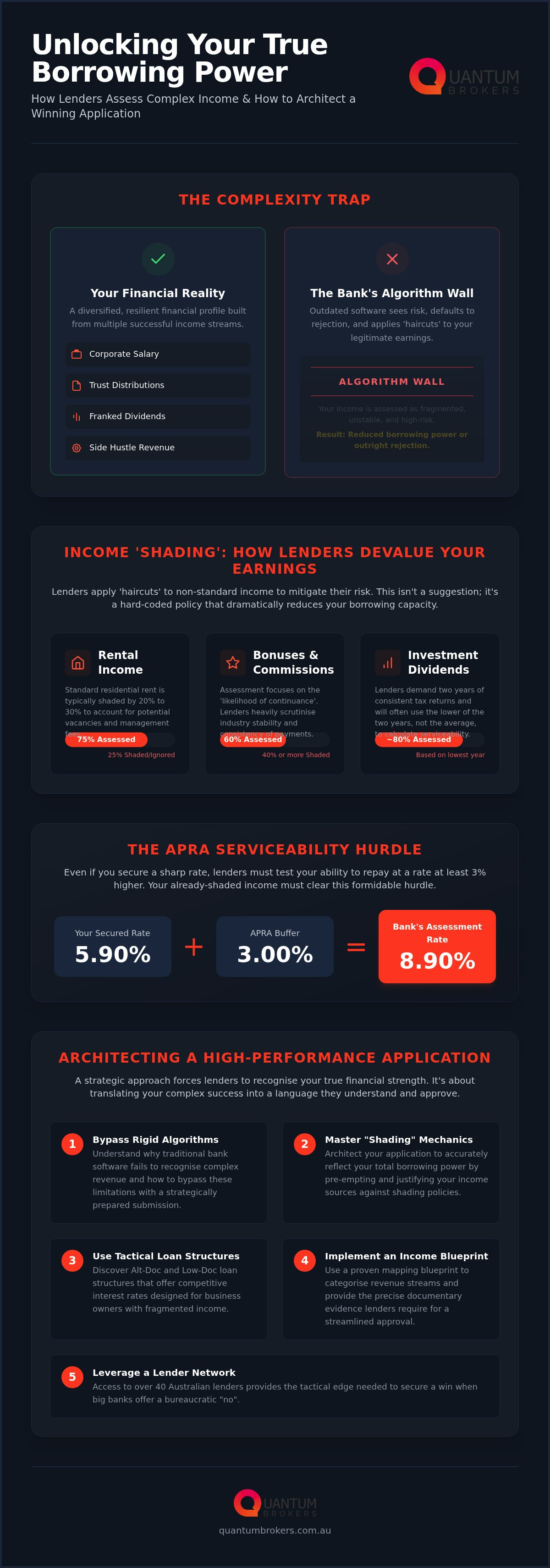
Architecting Your Application: The 5-Step Income Mapping Blueprint
Presentation isn't just a part of the process; it is the process. When securing a home loan with multiple income streams, your application must be engineered to withstand the scrutiny of a credit assessor who is looking for reasons to say "no." We don't just "send" files to banks. We architect a submission that pre-empts every potential objection before it's even raised. By following a methodical mapping blueprint, we transform your fragmented revenue into a high-performance credit narrative that commands approval.
- Step 1: Audit and Categorise. Stop viewing your revenue as a single lump sum. We separate your stable base salary from variable commissions, bonuses, and passive rental income to determine how each will be weighted.
- Step 2: Documentary Evidence. We gather the "Tactical Trio": Tax Portals, BAS, and Dividend Statements. This ensures your "on-paper" profit matches the cash flow hitting your accounts.
- Step 3: The Accountant Strategy. We collaborate directly with your tax professional. A robust accountant's declaration can often bridge the gap between a standard rejection and a strategic approval.
- Step 4: Policy Matching. Every lender has a different "shading" appetite. We identify the specific institution whose internal rules favour your unique mix of corporate salary and investment trust distributions.
- Step 5: The Tactical Submission. We present the final narrative directly to the human credit assessor, bypassing the automated "Algorithm Wall" that rejects non-standard profiles.
The Documentary Evidence Pack
Lenders demand transparency. The non-negotiables include six months of clean bank statements and your latest Notice of Assessment from the ATO. However, the "Secret Weapon" for side hustles or gig economy revenue is a detailed, interim profit and loss statement. This provides the real-time proof of stability that historical tax returns often lack. You can use our home mortgage Australia framework to organise your file and ensure no critical document is missing when we hit "submit."
The Narrative Summary
Every complex application needs an "Executive Summary." This is where we explain "one-off" expenses, such as a major equipment purchase or a temporary vacancy in a rental property, that shouldn't count against your servicing capacity. Quantum Brokers "architects" this narrative to ensure the credit assessor sees the resilience of your income rather than just the complexity. We fix the presentation so the bank can focus on the capacity. If you're ready to stop guessing and start winning, you can architect your submission here and secure the funding you need for your next acquisition.
Securing the Win: Why Strategic Brokerage Beats Physical Proximity
Physical proximity is a relic of 20th-century banking. If you are searching for a mortgage broker near me, you are asking the wrong question. In the high-stakes arena of 2026 property finance, your broker's postcode is irrelevant. Technical mastery is everything. You don't need a local contact for a coffee; you need a Strategic Architect who knows exactly which of the 40+ Australian lenders will honour 100% of your trust distributions. We thrive on the "no" answers you have received from the Big Four. We don't just "try" to secure a home loan with multiple income streams. We engineer the approval through technical persistence and policy leverage.
Our mastery comes at zero cost to the borrower. We are compensated by the lenders, meaning you access high-performance financial architecture without paying a broker fee. We move with speed. From our 24-hour borrowing power assessment to tactical settlement, our process is designed for efficiency. Securing a home loan with multiple income streams is a technical exercise in presentation and policy matching. We have spent years refining the frameworks required to make complex revenue look like a low-risk asset to credit assessors.
The Power of 40+ Lenders
Access to 40+ lenders isn't just about choice; it's about tactical leverage. We use competition to force policy exceptions that a single bank simply won't offer. If a traditional lender shades your NDIS revenue too heavily, we pivot to a specialist who understands SDA income mechanics. We act as the "Expert Fixer" for self-employed deals and complex trust structures that other brokers find too difficult. We don't accept standard "haircuts" on your legitimate revenue. We challenge them. This aggressive approach allows us to fast-track approvals even in a tight 2026 credit market.
Your Next Tactical Move
Stop letting banks dictate your borrowing capacity based on outdated software. Take the 24-hour borrowing power challenge today. It is time to initiate a confidential strategic briefing with Zac Hamdan’s team to map out your next acquisition. We are ready to design your path to success and provide the clarity you've been missing from traditional institutions. The system is complex, but your strategy doesn't have to be. Unlock your borrowing power with a Quantum Strategic Briefing.
Secure the Approval Your Portfolio Deserves
The Algorithm Wall is real, but it isn't impenetrable. You've built a diversified financial engine. It's time your bank recognised its true horsepower. Securing a home loan with multiple income streams requires more than just gathering paperwork; it demands a technical blueprint that translates complexity into creditworthiness. We have shown you how to navigate the 3% serviceability buffer and why shading doesn't have to be the end of your property goals.
We leverage our access to 40+ Australian lenders to bypass the rigid policies of the Big Four. We specialise in complex and multi-income lending because we believe your financial diversity is a strength, not a risk. Our team provides a free pre-approval and borrowing power assessment to ensure your next move is backed by data, not guesswork. Don't let a bureaucratic "no" stall your momentum.
Architect your approval with a free Quantum Strategic Briefing and take control of your financial narrative. Your 2026 property goals are within reach. We are ready to help you build them.
Frequently Asked Questions
Can I get a home loan if I have three different part-time jobs?
Yes, you can certainly secure an approval with multiple part-time roles. Most traditional banks require you to have held each position for at least six to twelve months to prove stability. We specialise in identifying lenders who aggregate these fragmented roles into a single, high-performance servicing figure rather than dismissing them as unstable casual labour. It's about presenting a cohesive narrative of your total earning capacity.
How do lenders treat income from a side hustle or gig economy work?
Lenders typically view gig economy revenue with extreme caution, often applying a "haircut" of 20% to 50% or ignoring it entirely if you have less than a two-year history. In the 2026 credit environment, we bypass this by using real-time profit and loss statements and Business Activity Statements. This provides the technical proof of consistency required to force a lender to recognise your side hustle as legitimate servicing power.
Will a bank count 100% of my rental income towards a new mortgage?
Standard banks rarely count 100% of your rent; they usually shade it by 20% to 30% to account for vacancy buffers and management fees. This is a significant blow to your borrowing power. We use our access to 40+ lenders to find institutions with a higher appetite for risk, particularly those that offer more generous weighting for high-yield assets like NDIS or SDA investments.
Can I use dividend income from my share portfolio to increase my borrowing power?
Dividend income is a powerful tool for a home loan with multiple income streams, provided you can show a two-year history of receipt. Lenders will typically look at your net dividends after franking credits are applied. We architect your submission to ensure these passive streams are fully integrated into your servicing profile, proving to the credit assessor that your wealth is diversified and resilient.
What happens if my self-employed income fluctuates year to year?
Banks usually default to the lowest figure or a conservative average when they see fluctuating revenue. This often results in a "no" answer for business owners who have had a growth year. We solve this by using "add-backs" for non-cash expenses like depreciation or one-off equipment purchases. By re-engineering your taxable profit, we present a true reflection of your current cash flow to the lender.
Is it possible to get a home loan with only one year of tax returns?
Specialist lenders offer products specifically for borrowers who only have one year of tax returns available. This is a common requirement for a home loan with multiple income streams where a new revenue source has recently been established. We navigate these niche policies to secure competitive rates that rival the Big Four, ensuring you don't have to wait another twelve months to make your property move.
How does an Alt-Doc loan differ from a standard home loan for multiple income streams?
Alt-Doc removes the requirement for two years of full tax returns, relying instead on accountant letters or BAS. It is a strategic tool for high-net-worth individuals whose tax returns don't reflect their actual liquidity. While there is often a minor interest rate premium, the gain in borrowing capacity is usually substantial. It allows us to shop the policy rather than being restricted by rigid bank software.
Why did my bank reject my application despite me having a high total income?
High income is meaningless if it is poorly structured or hits the "Algorithm Wall" of a major bank. Rejections often occur because the lender's software cannot process complex trust distributions or because the APRA 3% stress test was applied to shaded income. We act as the Expert Fixer, re-architecting your application to pre-empt these automated declines and presenting a narrative that human credit assessors actually value.


